Most enterprises already run more AI than they can account for. Employees use AI assistants on personal accounts, AI features switch on inside SaaS tools, and AI agents start taking actions in CRM, ticketing and code repositories
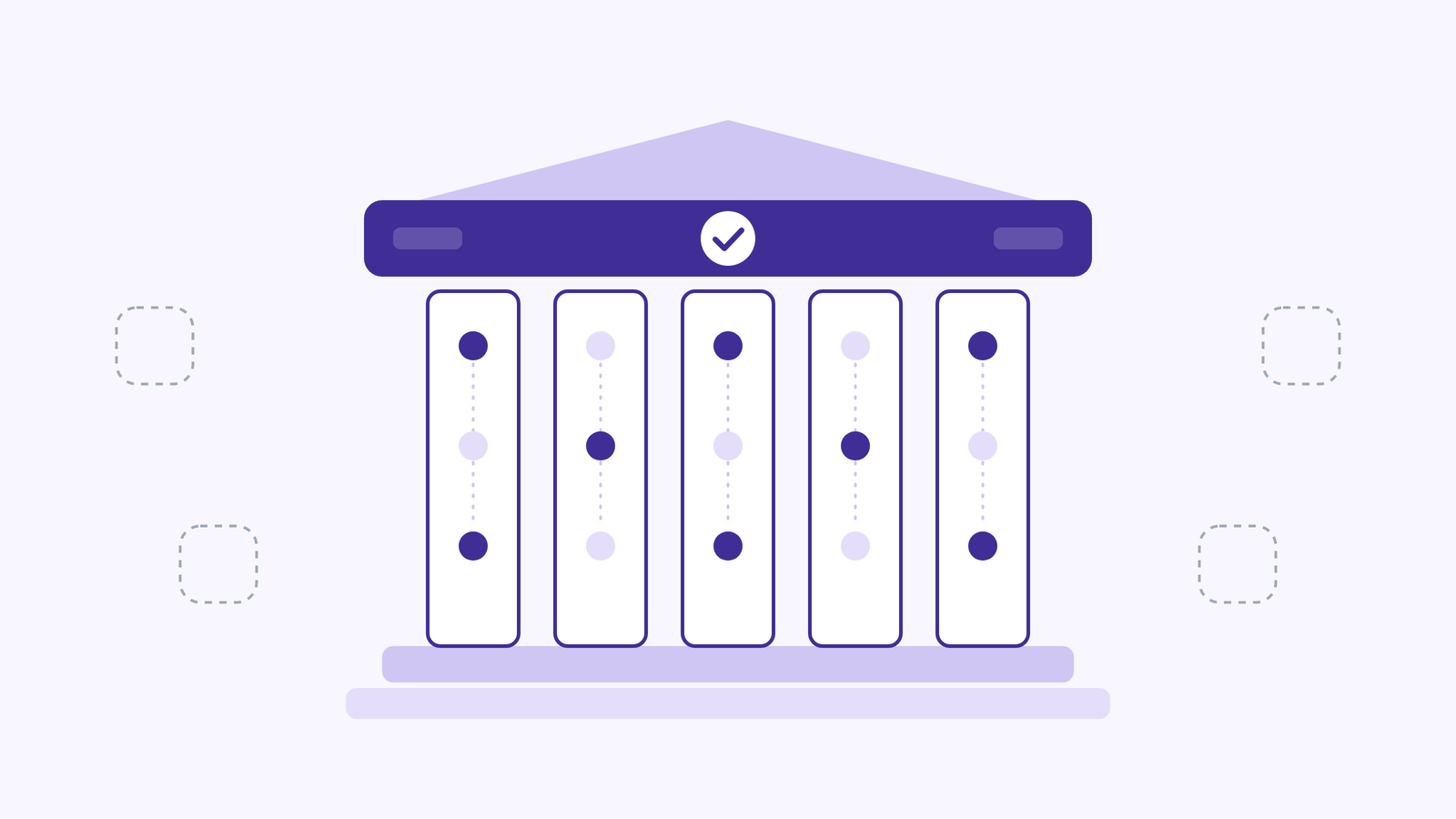
An AI governance framework is the structure that turns that activity into something the business can see, control and defend.
This guide explains what an AI governance framework is, how it differs from adjacent disciplines, the principles and components every framework needs, the regulations and standards that shape it, and how to implement one in a regulated, knowledge-worker-heavy enterprise. It is written for CTOs, CISOs, IT leaders, AI leaders and department heads who own the outcome.
An AI governance framework is the set of roles, policies, processes and technical controls that decide which AI an organization uses, who may use it, for what purpose, with which data, and how the organization proves those decisions were followed.
A working framework answers five questions:
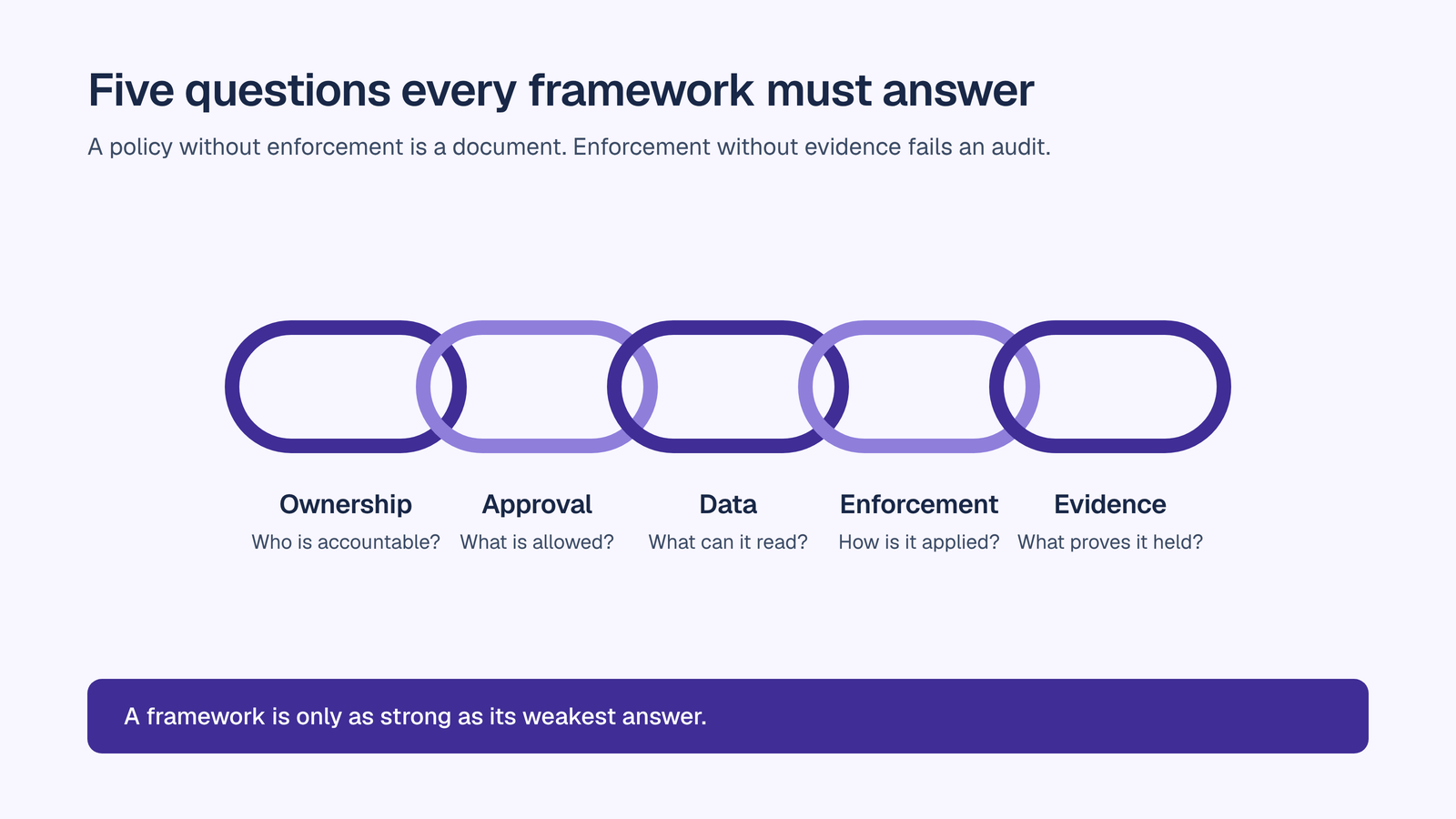
A framework is only as strong as its weakest answer. A policy without enforcement is a document. Enforcement without evidence fails an audit. Evidence without ownership leaves nobody to act on what it shows.
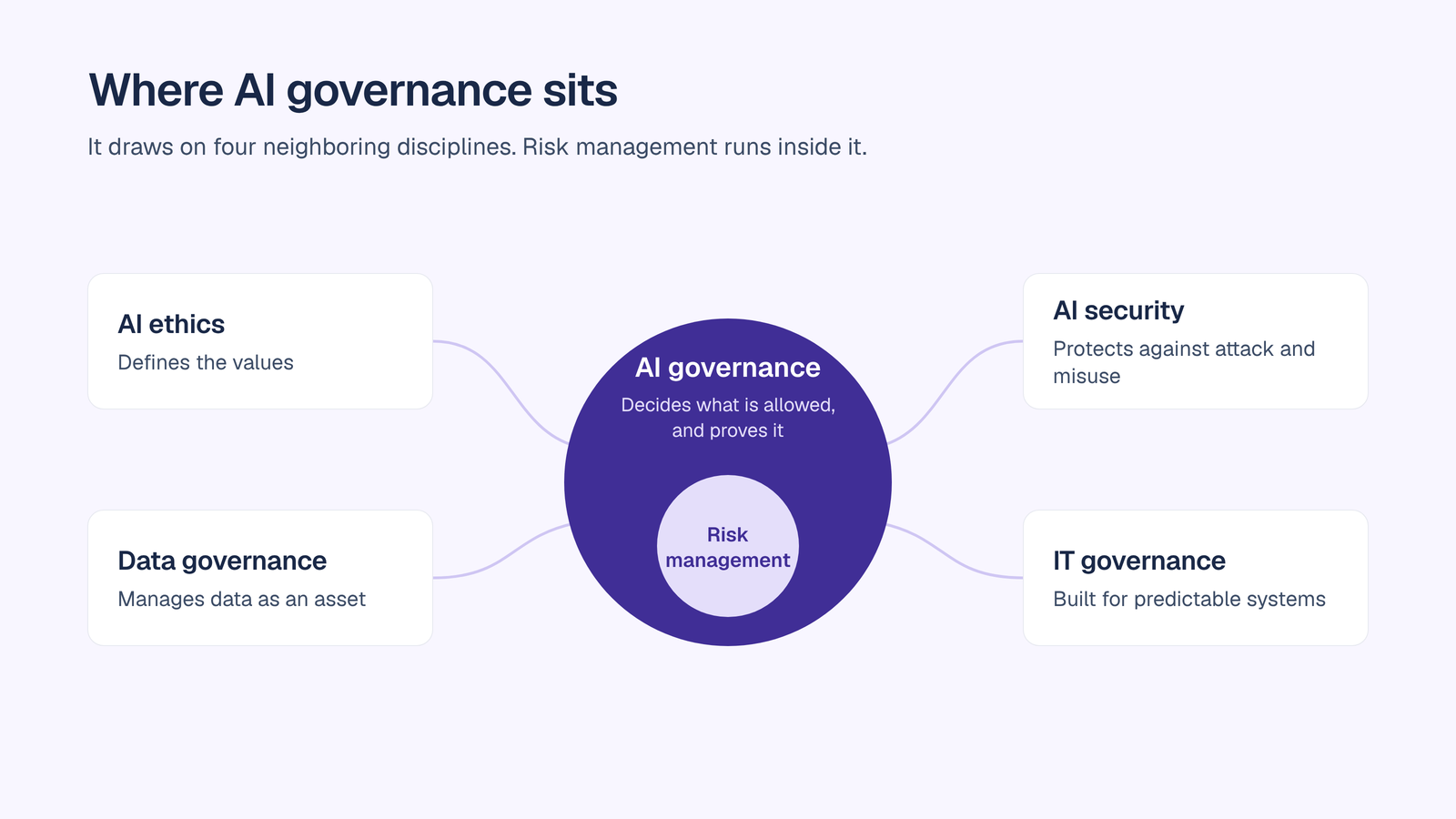
AI ethics defines values: fairness, transparency, accountability, privacy and respect for human agency. AI governance turns those values into decisions, rules and controls that people and systems actually follow.
An ethics statement with no governance behind it changes little day to day. Governance with no ethical baseline has no principled way to settle hard cases. Mature programs write the principles once and then encode them in policy, approval workflows and technical controls.
Data governance manages data as an asset: quality, lineage, classification, access and retention. AI governance builds on it but covers what data governance does not: what an AI system does with data, the outputs it produces, the actions agents take, and which model providers process the data.
Your data classification scheme is a direct input to AI policy. If a document is classified confidential, AI policy should state which AI may see it and whether personal data is redacted before any model call.
AI security protects AI systems and data from attack and misuse: prompt injection, sensitive information disclosure, supply chain compromise and excessive agency. AI governance decides what is allowed in the first place, and proves it.
The two share controls, including access limits, PII redaction and audit logs, and the CISO usually sits in both. For the security side, read what AI security is and why it is critical for enterprises.
Traditional IT governance frameworks such as COBIT and ITIL were built for systems that behave predictably, change through controlled releases, and arrive through procurement. AI breaks each of those assumptions:
IT governance still supplies change management, vendor management and access control. AI governance adds agent ownership, model choice, output review and continuous monitoring on top.
An AI risk management framework, such as the NIST AI Risk Management Framework, focuses on identifying, measuring and treating risk. AI governance is broader. It sets the structure risk management runs inside, and it covers decisions that are not only about risk, such as which tools to standardize on, how AI is funded, and how adoption and value are measured.
The two are designed to fit together. The NIST AI RMF treats governance as its first and cross-cutting function, Govern, which sets the policies, processes and accountability for its other three functions: Map, Measure and Manage.
These principles align closely with the trustworthiness characteristics in the NIST AI RMF and the OECD AI Principles.
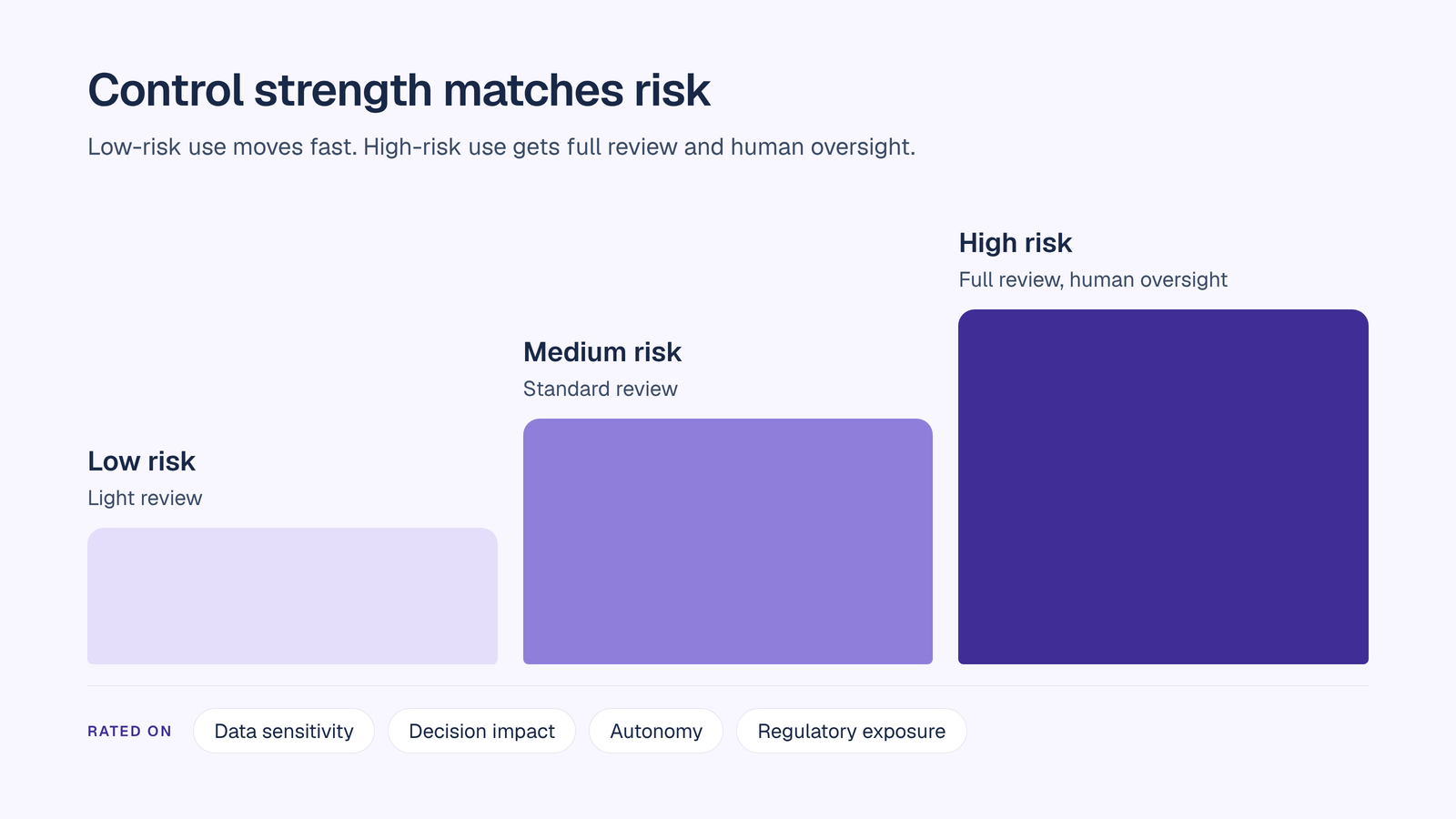
The EU AI Act sorts AI by risk: prohibited practices, high-risk systems, systems with transparency obligations, and minimal-risk uses. Its obligations phase in over several years:
If the AI you build or deploy affects people in the EU, check which of these apply to your use cases.
NIST AI RMF 1.0, published as NIST AI 100-1 on 26 January 2023, is voluntary and is the most common reference point for US enterprises. It organizes the work into four functions: Govern, Map, Measure and Manage. NIST’s Generative AI Profile (NIST AI 600-1) extends it to generative AI risks.
ISO/IEC 42001:2023 sets requirements for an AI management system, and organizations can be certified against it. ISO/IEC 23894:2023 gives guidance on managing AI risk. Customers and RFPs can require ISO/IEC 42001 certification alongside ISO/IEC 27001.
The OECD AI Principles, adopted in 2019 and updated in 2024, set out values-based principles for trustworthy AI that many national frameworks draw on.
OWASP’s 2026 edition ranks the main security risks for applications built on large language models. Prompt injection is first, sensitive information disclosure second and excessive agency third. It is the security checklist most teams use for LLM applications.
For the rollout plan around these steps, read the AI implementation strategy guide and the enterprise AI workspace checklist.
Governance holds only if it is checked continuously, not once a year.
What to log
What to monitor
How to audit continuously
How to respond
For security and IT leaders running the program across functions, see AI for IT and security teams and all solutions.
An AI governance framework works when ownership, policy, enforcement and evidence connect. Start with accountable owners and an inventory, classify by risk, write a short policy, enforce it where AI runs, and keep evidence exportable from day one. Use the NIST AI RMF as your spine, then add ISO/IEC 42001, the EU AI Act and your sector’s rules as they apply.
OrgLogic is the governed AI workspace where teams and their AI agents work together on shared company knowledge, with the framework’s controls built in:
Governance is on every plan, including Free, and seats are $8 per month on annual billing. See pricing for details. A publicly traded autonomous vehicle technology company with ~1,500 employees cut shadow AI 91% after deploying OrgLogic, and its engineers adopted it within 2 weeks.
Further reading: what is AI governance, shadow AI detection tools, best AI agent platforms, OrgLogic vs Claude Enterprise and OrgLogic vs Glean.
An AI governance framework is the set of roles, policies, processes and technical controls that decide which AI an organization uses, who may use it, for what purpose and with which data, and how the organization proves those rules were followed.
The core components are a governance structure with named owners, an AI inventory, risk classification, policies and standards, technical controls such as PII redaction and per-agent permissions, approval workflows, monitoring and audit trails, cost governance, training, vendor management and continuous improvement.
Most US enterprises use the NIST AI Risk Management Framework as their spine, because it is voluntary and widely recognized. They add ISO/IEC 42001 when customers require certification, the EU AI Act when their AI affects people in the EU, and sector rules such as HIPAA, SR 11-7 or the NAIC Model Bulletin.
AI ethics defines the values an organization holds about AI, such as fairness and transparency. AI governance turns those values into decisions, rules and controls, and checks that they are followed.
No single law requires a framework by that name, but several rules effectively require one. The EU AI Act sets risk management and documentation duties for high-risk AI, the NAIC Model Bulletin expects insurers to keep a written AI program, and laws such as HIPAA and GDPR apply whenever AI processes regulated data.
An AI governance council should own it, with an executive sponsor and members from security, IT, legal, privacy, HR and the business. Each AI system and agent then needs its own named, accountable owner.
OrgLogic enforces governance where AI runs. It redacts PII before every model call, uses BYOK so data flows directly to model providers, gives every agent an accountable manager and per-connector permissions, caps spend per team, and logs every thread message and agent action in an exportable audit trail. xGovernance is on every plan, including Free.

Single-model AI tools lock you into one provider at $25-60/seat. OrgLogic is a multi-model AI workspace with named Agents that act in your systems (Salesforce, Jira, Confluence, ServiceNow), packaged Skills for domain expertise, and full governance at $8/seat. You get every model, not just one.

Bring Your Own Key means you connect your own API keys from OpenAI, Anthropic, Google, or any provider. Your data flows directly to the model provider. OrgLogic never sees, stores, or processes your prompts or responses. Zero surcharge on your own keys. This is the #1 requirement for security teams evaluating enterprise AI platforms.
An Agent is a named AI worker with a defined job, connected to your systems via Connectors. A Skill is packaged expertise that teaches an Agent how to do specific work consistently. Unlike a generic chatbot, a Deal Prep Agent with a Salesforce Connector pulls real CRM data and produces structured call briefs. Skills are reusable across Agents, versioned, and authored in plain language.
Every Workspace includes per-Agent Connector permissions (each Agent gets scoped access, not blanket access), Agent-level audit trails, automatic PII redaction, per-team budget controls, model-level access controls, and configurable guardrails. Governance is the default environment on every plan, including Free. SOC 2 Type II, ISO 27001, HIPAA, and GDPR compliant.
The Free plan covers 25 users with $500 in credits ($20 per active user, pooled). The Business plan is $8/seat/month (annual) or $10 monthly. The seat fee covers the full platform: Agents, Skills, Connectors, governance dashboard, 5 surfaces, and all features. Model usage is separate: BYOK at zero surcharge, or OrgLogic-managed models at cost + 6%.
80% of employees already use AI tools without IT approval. OrgLogic replaces fragmented, ungoverned tools with one AI workspace employees actually want to use, available on web, Slack, Teams, Chrome, and API. One customer, a regulated tech company with 1,500 employees, reduced shadow AI by 91% within 6 weeks while cutting AI spend by 70%.
OrgLogic Connectors integrate with Salesforce, Jira, Confluence, ServiceNow, SharePoint, Google Workspace, Slack, SAP, and more via custom APIs. Each Connector has per-Agent permission scopes controlled by IT, so your Deal Prep Agent only accesses the Salesforce objects you approve. The Connector library is growing and new integrations ship regularly.
Self-serve signup takes 30 seconds. Connect your API keys in 2 minutes. Deploy pre-built Agents for sales, support, engineering, HR, and legal on day one. The Free plan (25 users, full governance) lets you pilot without procurement. One customer had engineers adopting within 2 weeks across Slack and Chrome. Enterprise plans add SSO/SCIM, VPC, and on-prem deployment.
