
Enterprises now run AI systems that make decisions, touch customer data and take actions inside business tools. Each one carries risk: wrong answers, leaked data, regulatory exposure, and AI that nobody in the company can see
AI risk management is the practice of finding those risks, rating them, controlling them, and keeping proof that the controls work.
This guide explains what AI risk management is, the four types of AI risk, the frameworks that structure the work, the compliance requirements that shape it, and a practical path to implementation. It is written for CTOs, CISOs, IT leaders and department heads in regulated and trust-sensitive industries.
AI risk management is the ongoing process of identifying how AI systems can cause harm, measuring how likely and how severe that harm is, controlling it with policy and technology, and keeping evidence that the controls hold. It covers AI an organization builds, AI it buys, and AI its employees use every day.
Three things set it apart from general IT risk management:
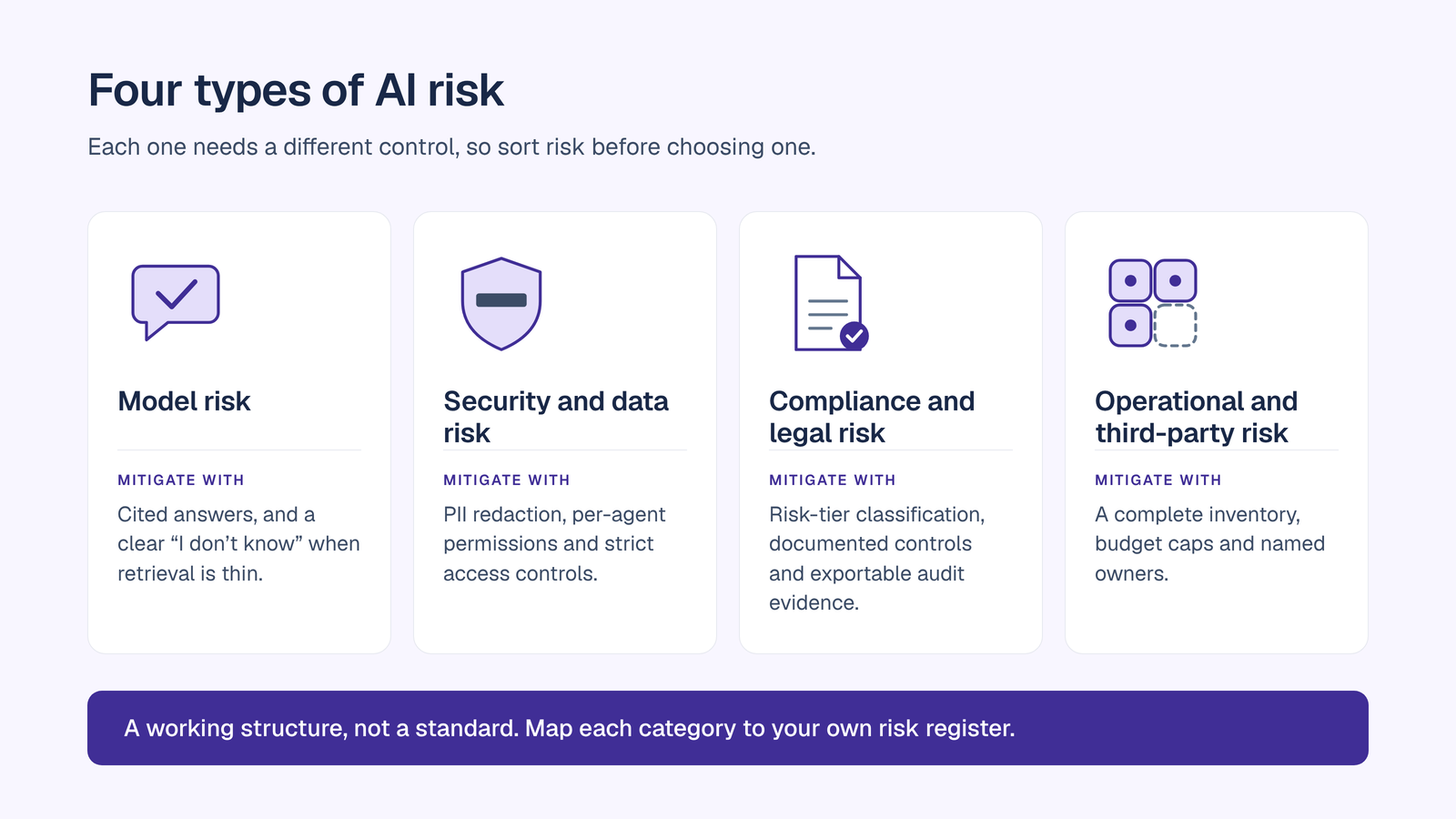
This guide sorts AI risk into four categories. This is a working structure rather than a single standard, so map each category to your own risk register.
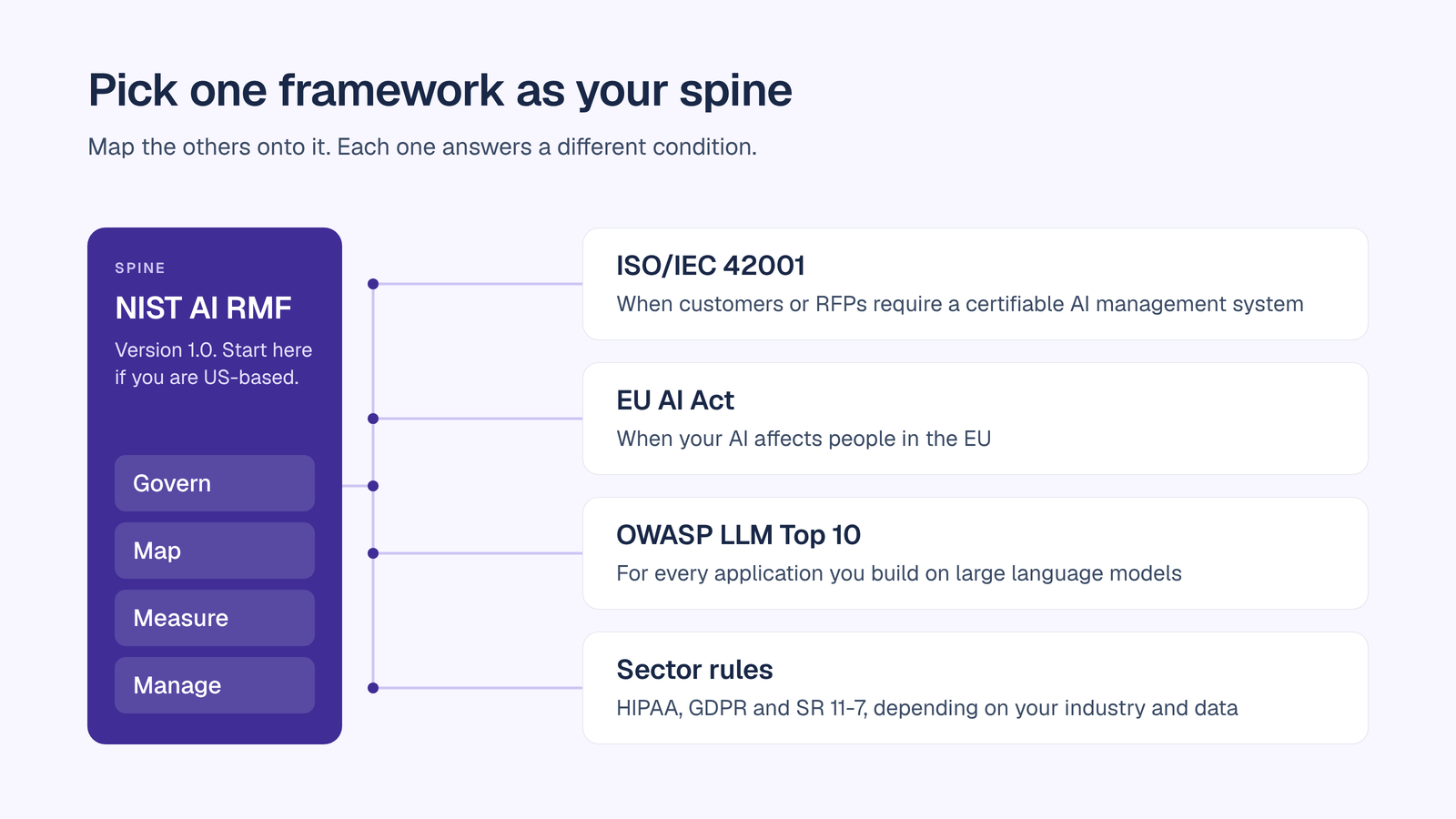
The NIST AI RMF is the US reference point for AI risk. It was published as NIST AI 100-1 on 26 January 2023 and is voluntary. It organizes the work into four functions:
ISO/IEC 42001 is a management system standard for AI. It sets requirements for establishing, implementing, maintaining and improving an AI management system. Because it is certifiable, customers and RFPs can require it.
The EU AI Act classifies AI use cases by risk, and obligations scale with the tier. High-risk systems under Annex III face requirements for risk management, documentation and human oversight. If the AI you deploy affects people in the EU, check whether the Act applies to your use case.
OWASP’s list is the security checklist for applications built on large language models. The 2026 edition, released in August 2026, ranks the risks as follows: LLM01 Prompt Injection, LLM02 Sensitive Information Disclosure, LLM03 Excessive Agency, LLM04 Supply Chain, LLM05 Data and Model Poisoning, LLM06 Unbounded Consumption, LLM07 Misinformation, LLM08 Hidden Context Exposure, LLM09 Vector and Embedding Weaknesses, and LLM10 Improper Output Handling.
Regulated industries add their own requirements. Banks in the US are expected to follow the model risk management guidance in SR 11-7. Healthcare organizations handling protected health information must meet the HIPAA Security Rule. Organizations handling personal data of EU residents must meet GDPR.

Enterprise buyers ask AI vendors for a consistent set of proofs:
Ask each vendor to show these requirements in writing and in its audit reports, not only on a product page.
An enterprise with 8,000+ employees across multiple countries had AI usage fragmented across engineering, operations and corporate teams. Twelve unauthorized AI tools ran with no audit trail and no PII protection, and government contracts made its compliance requirements especially strict.
The company deployed OrgLogic, consolidated its AI use into one governed AI workspace, and ran it with BYOK and a dedicated single-tenant VPC, so data flowed directly to model providers and OrgLogic never saw it. Routed AI traffic gained a full audit trail and model-level access controls.
The lesson: consolidation and an audit trail are the first controls to put in place, before any policy work begins.
A publicly traded autonomous vehicle technology company with ~1,500 employees had engineering teams using 6+ AI tools on personal accounts. Proprietary algorithms and sensor data were being pasted into uncontrolled AI, with no visibility and no governance.
After deploying OrgLogic, shadow AI dropped 91%, and engineers adopted the governed alternative within 2 weeks. BYOK kept proprietary data inside the company’s environment, and smart routing let engineers pick the right model for each task.
The lesson: a sanctioned option that is better than the personal account reduces risk faster than a prohibition does.
For the operating model that sits behind these steps, read AI implementation strategy.
Frameworks and standards
Platforms
AI governance platforms keep the inventory, enforce policies at runtime, log audit trails and cap spend. Read the AI governance guide for how these platforms work and what to evaluate.
OrgLogic’s AI governance platform applies these controls to the AI employees and agents use every day: PII redaction before every model call, BYOK with zero surcharge, per-agent permissions, an audit trail on every thread message and agent action, and per-team budget caps. Governance is enforceable on traffic that flows through OrgLogic. Related controls are covered in the AI audit trail and AI cost management pages.
Related reading
No single framework covers everything. Pick one as the spine of your program and map the others onto it.
For teams that own the risk in practice, the IT security solutions, legal solutions, finance solutions and sales solutions pages show how the same controls apply by function. Comparing platforms? See OrgLogic vs Claude Enterprise and OrgLogic vs Glean.
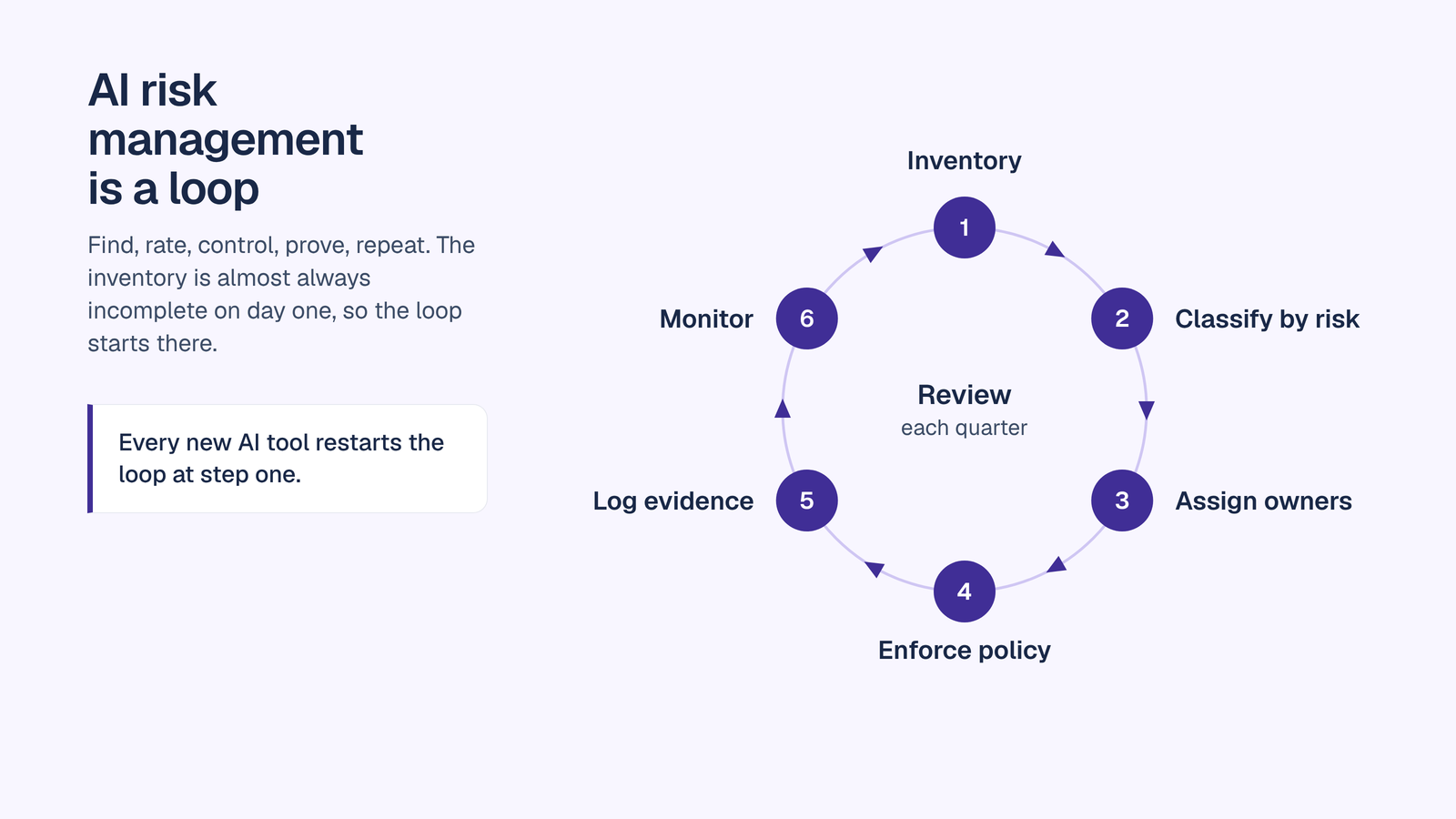
AI risk management works when it is continuous: inventory, classify, assign owners, enforce policy, log evidence, monitor and review. Choose one framework as your spine, match controls to the four risk types, and make your evidence exportable before the audit arrives.
AI risk management is the ongoing process of identifying how AI systems can cause harm, measuring the likelihood and severity of that harm, controlling it with policy and technology, and keeping evidence that the controls work. It covers AI an organization builds, buys and uses.
The NIST AI RMF 1.0, published as NIST AI 100-1 in January 2023, is a voluntary US framework. It organizes AI risk work into four functions: Govern, Map, Measure and Manage.
This guide groups AI risk into four types: model risk (wrong, biased or inconsistent outputs), security and data risk (prompt injection, data leakage and excess access), compliance and legal risk (regulation, contracts and intellectual property), and operational and third-party risk (shadow AI, uncontrolled spend and unowned agents).
Some obligations apply by law. The EU AI Act applies to certain AI use cases, and GDPR and HIPAA apply where personal data or protected health information is involved. The NIST AI RMF is voluntary. Check which obligations apply to your industry, geography and data.
NIST AI RMF is a voluntary risk framework that organizes AI risk work into four functions. ISO/IEC 42001 is a management system standard that sets requirements for running an AI management system, and it can be certified.
Start with an inventory of the AI in use, including tools employees adopted on their own. Assign an accountable owner to each system and agent, classify each use case by risk, write policies that tools can enforce, and pilot a platform on live traffic before committing to a rollout.

Single-model AI tools lock you into one provider at $25-60/seat. OrgLogic is a multi-model AI workspace with named Agents that act in your systems (Salesforce, Jira, Confluence, ServiceNow), packaged Skills for domain expertise, and full governance at $8/seat. You get every model, not just one.

Bring Your Own Key means you connect your own API keys from OpenAI, Anthropic, Google, or any provider. Your data flows directly to the model provider. OrgLogic never sees, stores, or processes your prompts or responses. Zero surcharge on your own keys. This is the #1 requirement for security teams evaluating enterprise AI platforms.
An Agent is a named AI worker with a defined job, connected to your systems via Connectors. A Skill is packaged expertise that teaches an Agent how to do specific work consistently. Unlike a generic chatbot, a Deal Prep Agent with a Salesforce Connector pulls real CRM data and produces structured call briefs. Skills are reusable across Agents, versioned, and authored in plain language.
Every Workspace includes per-Agent Connector permissions (each Agent gets scoped access, not blanket access), Agent-level audit trails, automatic PII redaction, per-team budget controls, model-level access controls, and configurable guardrails. Governance is the default environment on every plan, including Free. SOC 2 Type II, ISO 27001, HIPAA, and GDPR compliant.
The Free plan covers 25 users with $500 in credits ($20 per active user, pooled). The Business plan is $8/seat/month (annual) or $10 monthly. The seat fee covers the full platform: Agents, Skills, Connectors, governance dashboard, 5 surfaces, and all features. Model usage is separate: BYOK at zero surcharge, or OrgLogic-managed models at cost + 6%.
80% of employees already use AI tools without IT approval. OrgLogic replaces fragmented, ungoverned tools with one AI workspace employees actually want to use, available on web, Slack, Teams, Chrome, and API. One customer, a regulated tech company with 1,500 employees, reduced shadow AI by 91% within 6 weeks while cutting AI spend by 70%.
OrgLogic Connectors integrate with Salesforce, Jira, Confluence, ServiceNow, SharePoint, Google Workspace, Slack, SAP, and more via custom APIs. Each Connector has per-Agent permission scopes controlled by IT, so your Deal Prep Agent only accesses the Salesforce objects you approve. The Connector library is growing and new integrations ship regularly.
Self-serve signup takes 30 seconds. Connect your API keys in 2 minutes. Deploy pre-built Agents for sales, support, engineering, HR, and legal on day one. The Free plan (25 users, full governance) lets you pilot without procurement. One customer had engineers adopting within 2 weeks across Slack and Chrome. Enterprise plans add SSO/SCIM, VPC, and on-prem deployment.
