
IT Governance
See and govern every AI your company runs
Every model, every agent, every retrieval: logged, attributable and exportable. Sensitive data redacted before it reaches a model. Nothing trained on your data, contractually. On every plan, including Free.
Free 25 users · $500 in credits · No credit card required
You cannot govern what you cannot see.
Your people adopted AI without asking. That is not a discipline problem. It is what happens when a tool is free, useful and one click away.
The two obvious responses are both bad. Block it, and the work moves to personal accounts where you have no visibility at all. Allow it, and you are carrying risk you cannot measure, on data you cannot trace, through vendors you never reviewed.
There is a third option, and it is why this product exists. Give people something better, governed from the first message, and route what they will not give up.
80%
of employees already use unsanctioned AI tools. IBM, 2025
$670K
additional cost of a shadow AI breach. IBM, 2025
$0
governance costs nothing on our Free plan. All of it, from 1 user.
The controls
Seven things you can prove on Monday morning.
Not a roadmap and not a tier. Every control below is on for every organization from the first message, whether you are 5 people on Free or 5,000 on Enterprise.
Nothing trained on your data
Contractual. Data sent to model providers goes by API only, is not retained beyond the time needed to answer, and every provider is under a DPA prohibiting use for training.
PII redacted before the model
Auto-detected and masked before any prompt reaches a model. Every call, every Space, every agent. The rules are yours.
Every action on the record
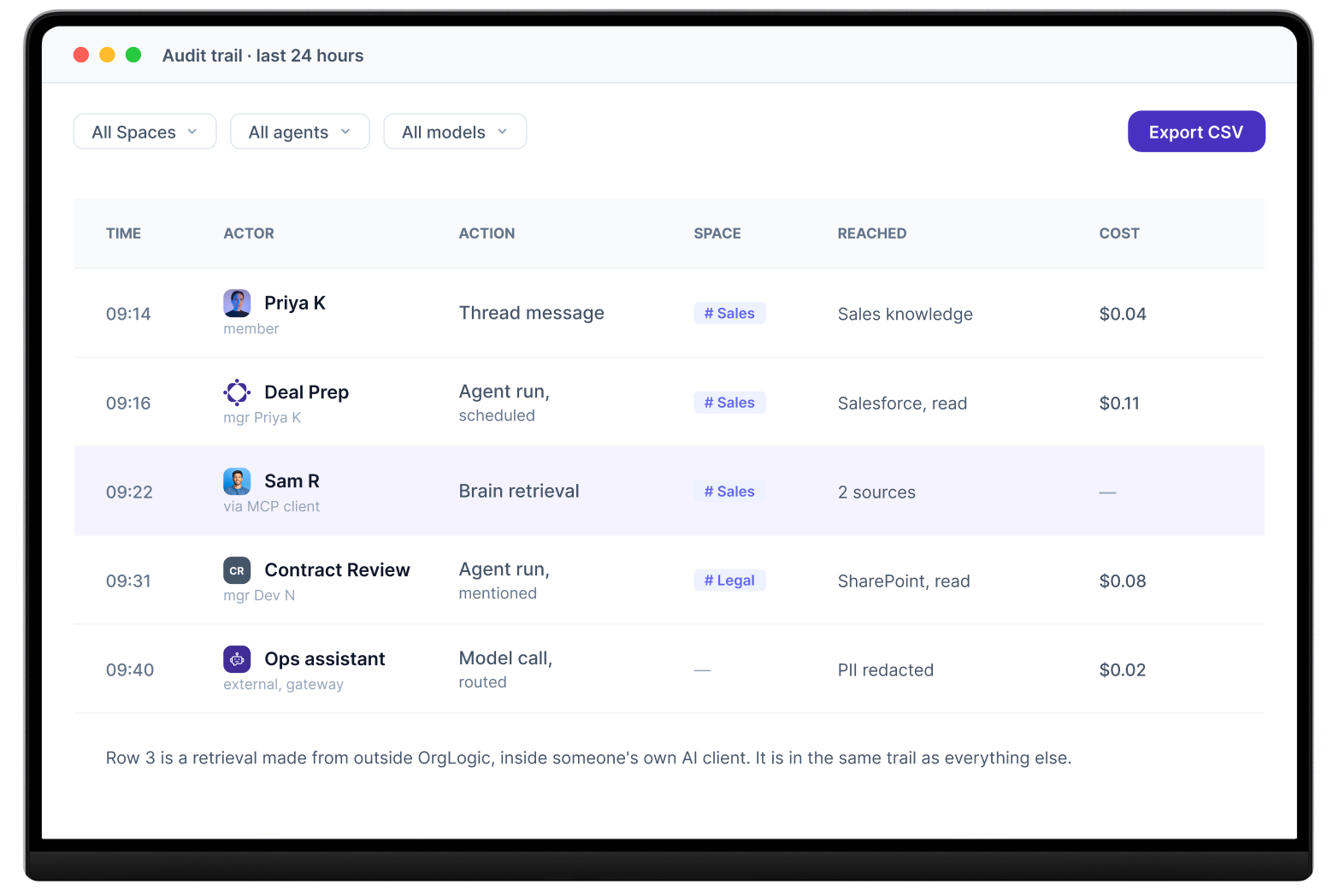
Thread messages, agent runs and Brain retrievals, including retrievals made from outside OrgLogic. Searchable, exportable.
Per-agent scope, not blanket access
Read or write per agent per connector, revocable in seconds. A named manager is accountable for every agent and appears on every line it produces.
Budgets that actually stop
Per-team limits with alerts and hard caps. Spend visible by team, user, model and agent, in real time.
You choose which models
Model availability per organization and per team. Content guardrails organization-wide. Admin control over MCP connections.
And the boundary that makes the rest work. Nothing appears in a Space unless the Space was granted it or a member deliberately put it there. A person's own connections and the knowledge created through them stay at user level until they share them.
Audit trail
Answer the question an auditor actually asks.
Which agent reached which system, for which user, at what time, under whose accountability. One export, not a two-week project.
Everything, in one trail
Every thread message, every agent action and every Company Brain retrieval, logged with organization, Space, thread, actor, agent, agent manager, model, sources and cost.
Including what happens outside OrgLogic
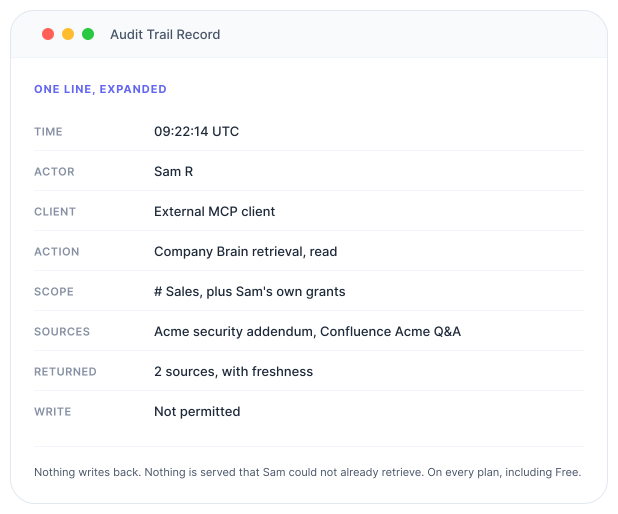
When someone connects the Company Brain to their own AI client, those retrievals land in the same trail, with the client, the user, the scope and the sources served. Visibility over AI that used to have none.
The Space dimension
Because work happens in team Spaces rather than private windows, the trail knows which team did what. That does not exist in a product built around individual chat histories.
Accountability is recorded, not assumed
Every agent has a named manager who is its only editor. That manager's ID is on every line the agent produces, and being the manager grants no access to what the agent read.
Retention on your terms
Administrator-configurable. Export to CSV and hand it straight to an auditor.
PII redaction
Redacted before the model, not after.
A masked prompt that never carried the identifier is a different risk posture from a logged prompt that did. This is the control that changes the answer on confidential documents.
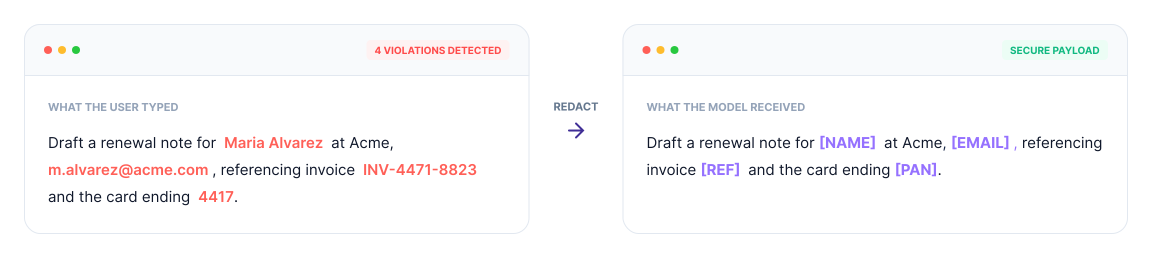
Auto-detected, administrator-configurable, applied pre-model on every call from every Space and every agent. Guardrails and content policies are set organization-wide and testable before rollout.
A pre-opening cognitive city development in Florida redacted 1.8M PII items in flight, masked before reaching any model.
Visibility
Complete for the company. Proportionate for the person.
Two things a governance product has to get right at once, and most get only the first.
Shared Spaces
Admins see all of it
Organization admins see every shared Space's membership, knowledge, connections and audit trail. Restricted Spaces included. No team can quietly stand up an ungoverned corner of the company.
- Membership and roles
- Every knowledge base and connection
- The full audit trail
- Default visibility set organization-wide
Private Spaces
Logged, and not casually browsable
Personal activity is in the audit trail like everything else. It does not appear in the in-app audit browser. Reaching it takes a compliance export under a role granted separately from Admin, and that export is itself audited.
- Nothing is outside the record
- Separate role, granted deliberately
- Every export leaves its own line
- Available for legal hold and investigation
This is the design that lets a company say yes to everyone. Employees adopt because their own Space is not a surveillance feed. Security signs off because nothing is unlogged and an investigation is always possible.
The AI you already run
Replace nothing. Ground it, and govern what routes through you.
Claude, ChatGPT, Copilot and Claude Code keep working. Two separate things apply to them, and it is worth being precise about which does what.
Context, over MCP
Give those tools your company's knowledge
A person connects the Company Brain to their MCP-capable client and it answers from your accounts, docs and decisions. Scoped to that person: they get back only what they could already retrieve inside OrgLogic.
- Read only, no write-back
- Every retrieval in the audit trail
- Disable, restrict or monitor organization-wide
- On every plan, including Free
Control, through the Gateway
Govern their model traffic
Register an agent or a client, give it its own gateway credential, and its model calls inherit your controls.
- One credential per agent, revoked in one click
- Budget caps with alerts and hard stops
- PII redaction before the model
- Observe mode, or block
A team can take either. Gateway governance covers model traffic routed through OrgLogic and does not reach what a client does outside those calls, which is the honest boundary and the reason routing matters.
Identity and deployment
Fits the way your company already runs.
Identity
SSO with SAML, Okta and Azure AD, SCIM provisioning and domain verification on Enterprise. Organization and Space roles, bulk invites, deactivation and agent approval workflows on every plan.
Deployment
Multi-tenant cloud on every plan. Single-tenant VPC and on-premise on Enterprise. Production Pilots deploy to a dedicated single-tenant VPC regardless of plan.
Foundations
TLS 1.3 in transit, AES-256 at rest, complete data isolation between organizations, administrator-configurable retention.
Compliance
The evidence procurement asks for.
SOC 2 Type II
ISO 27001
GDPR
HIPAA BAA
Available for security review: the SOC 2 Type II report and ISO 27001 certificate on request, a security overview covering data flow, encryption and access controls, the published sub-processor list, a DPA, and an incident response summary.
In practice
Confidential IP in front of frontier models, with sign-off first
A pre-opening cognitive city development in Florida, fourteen districts, built by a confidential enterprise, put its master plans, designs and investor records in front of frontier models with zero confidential leaks, redacting 1.8M PII items in flight, with CISO sign-off in month one.
Their position going in was that autonomous agents would never clear security review without per-agent permissions and agent-level audit trails. Governance shipped as the first deliverable, before any confidential corpus reached a frontier model. It now runs 14 agents in production across finance, legal, procurement, investor relations and program management.
Zero
Confidential leaks
1.8M
PII items redacted
14
Agents in production
Month 1
CISO sign-off
Pricing
$8 a seat, and both cost layers on the table.
Free
$0
Up to 25 users, no seat minimum, no card.
Unlimited Spaces, threads and agents
Full governance
$500 in pooled model credits
Standard
$8
seat / mo
Up to 25 users, no seat minimum, no card.
Everything in Free
API and SDK
Enterprise
Custom
100 seat minimum.
SSO, SCIM, domain verification
Single-tenant VPC and on-premise
Model usage is separate and we say so plainly: your own keys at zero surcharge, or OrgLogic-provisioned at cost plus 6% on prepaid credits. Bundled tools hide that layer inside a $25 to $60 seat, which is why they cannot tell you what your model spend actually is.
FAQ
AI governance FAQ
What is an AI governance platform?
Somewhere a company can see and control how AI is used across it: which models are available to whom, what data reaches them, what agents are allowed to do, what it costs, and a record of all of it. The distinction that matters in practice is whether governance covers only the vendor's own product or extends to the AI tools your people already run.
What is shadow AI and what do we do about it?
Employees using AI tools the company has not approved, usually on personal accounts, with company data. IBM found 80% of employees do it (IBM, 2025). Blocking pushes it further out of sight. The workable answer is to give people something better that is governed by default, and to route the tools they will not give up.
Is our data used to train models?
No, contractually. Data sent to model providers goes by API only, is not retained beyond the time needed to generate a response, and every provider is under a DPA prohibiting use for training. That holds whether you use our keys or your own.
What exactly is in the audit trail?
Organization, Space, thread, actor, agent, agent manager, model, sources and cost, for every thread message, every agent action and every Company Brain retrieval, including retrievals made from a third-party AI client over MCP. Searchable and exportable.
Can admins read employees' private conversations?
Private Space activity is logged like everything else, but it is not shown in the in-app audit browser. Reaching it requires a compliance export under a role granted separately from Admin, and every such export is itself audited. Shared Spaces, including restricted ones, are fully visible to organization admins.
How does PII redaction work?
Sensitive data is automatically detected and masked before any prompt reaches a model. It runs pre-model on every call from every Space and every agent, and the rules are administrator-configurable and testable before rollout.
How are agent permissions scoped?
Read or write per agent per connector, not blanket access. An agent acts only where its own permissions and its Space's grants overlap. Each agent has a named manager who is its only editor and appears on every audit line it produces. Revoke in seconds.
Our people want to use the Brain inside Claude. What are we exposing?
Only what each person already had. A request from an outside client is scoped to the user who made it, retrieval is read only so nothing writes back, every retrieval is logged, and admins can disable, restrict or monitor MCP connections organization-wide.
Can we govern ChatGPT, Claude or Copilot?
Their model traffic, once routed through the OrgLogic gateway: model controls, per-agent budget caps with hard stops, PII redaction before the model, a per-agent credential you can revoke in one click, and a per-agent audit trail. That scope is model traffic and does not extend to what those clients do outside routed calls.
Which certifications do you hold?
SOC 2 Type II and ISO 27001, both at the organization level, with a HIPAA BAA available and GDPR compliance. Reports and certificates are available on request for security review.
Is governance really on the free plan?
Yes, all of it. SSO, SCIM, domain verification, VPC and on-premise sit on Enterprise, which carries a 100-seat minimum. Everything else on this page is available from your first user.
Can we deploy in our own environment?
Single-tenant VPC and on-premise are available on Enterprise. Production Pilots deploy to a dedicated single-tenant VPC regardless of plan.
Govern AI adoption without slowing the business down.

of employees use unsanctioned AI tools with no audit trail or PII protection
average extra cost of a breach involving shadow AI, beyond a standard data breach
Source: IBM Cost of a Data Breach 2025
reduction in shadow AI when a 1,500-person technology company deployed OrgLogic
The gap between what IT sanctions and what teams actually use grows every week, with no audit trail and no PII protection behind it.
✓ One customer cut shadow AI by 91% after moving to a governed workspace.

Use your own API keys from OpenAI, Anthropic, Google, or other providers. Prompts go directly to the model—OrgLogic only routes requests, enforces policy, and logs metadata, never storing your content. Zero markup on your own keys.

Every chat and every Agent action is logged: which Agent, which user, which Connector was accessed, which model, input and output. Searchable and exportable. Hand it to an auditor without standing up a project.

Sensitive data is automatically detected and redacted before any query reaches a model provider. Fires by default on every plan. Configurable by team and use case. No manual setup required to get started.
Security approves exactly what each Agent can access, not blanket Connector access. Your Deal Prep Agent reads specific Salesforce objects. Your PR Agent touches only the repos you allow. Scoped per Agent, per Connector, by read and write. Revoke in seconds.

Set spending limits per team and per Agent, with real-time cost analytics and alerts before budgets are hit. Full cost visibility across the org, by team, model, and Agent.

Decide which models are available to which teams. Enforce content guardrails workspace-wide. SSO, SAML, and SCIM on Enterprise for centralized provisioning and deprovisioning, with VPC and on-prem deployment options.
Governance feature

ChatGPT Ent.
Claude Teams
Glean
Langdock
M365 Copilot
BYOK (zero markup)
✓ Yes
✓ Yes
--
✓ Yes
✓ Yes
✓ Yes
Full audit trail
✓ Yes
Activity logs
✓ Yes
✓ Yes
✓ Yes
M365 audit
Agent-level audit trail
✓ Yes
--
--
--
--
--
Governance on Free plan
Default
--
--
--
--
--
PII redaction (auto, pre-model)
✓ Yes
--
--
✓ Yes
✓ Yes
Limited
Per-Agent Connector permissions
✓ Yes
✓ Yes
✓ Yes
--
--
✓ Yes
Per-team budget controls
✓ Yes
✓ Yes
✓ Yes
--
✓ Yes
✓ Yes
Model-level access per team
✓ Yes
✓ Yes
--
✓ Yes
✓ Yes
✓ Yes
SSO / SCIM
Enterprise
✓ Yes
Limited
✓ Yes
✓ Yes
✓ Yes
VPC / on-prem
Enterprise
--
--
✓ Yes
✓ Yes
--
Seat price
$8/seat/mo + AI Usage
~$60/seat/mo
~$25/seat/mo
~$50+/seat/mo
~€20/seat/mo
$30 +M365 /mo
Verified outcome from an OrgLogic customer. 600+ enterprise deployments across
Troopr Labs AI products, SOC 2 Type II and ISO 27001 certified.
✓ SOC 2 Type II and ISO 27001 certified. HIPAA with a BAA available, and GDPR compliant.
✓ TLS 1.3 in transit, AES-256 at rest, keys managed via AWS KMS.
✓ AI guardrails on inputs and outputs, with a full audit trail across every interaction.
✓ Regular scans and penetration tests, with summaries available under NDA.
✓ No training on customer data. A contractual guarantee on every plan.

Live in five minutes. No sales call required.
The free pilot includes full governance for 25 users with $500 in AI credits. No credit card, no waiting for a demo to get started.
Signup takes 30 seconds. Invite teammates by email or domain. Governance, including BYOK, audit trail, and PII redaction, is on by default. Zero configuration required.
Bring your own API keys from OpenAI, Anthropic, or Google at zero surcharge. Connect Salesforce, Jira, Confluence, or ServiceNow with per-Agent permission scopes that IT controls.
Start with multi-model chat or deploy pre-built Agents for sales, support, engineering, HR, and legal. Every Agent operates inside your governed Workspace. Every action logged.
What does BYOK mean and how does it work?
Bring Your Own Key means you connect your own API keys from OpenAI, Anthropic, Google, or any provider. Two separate data paths: with BYOK, chat and agent traffic flows directly from your environment to your model providers, and OrgLogic never sees, stores, or trains on it. The Company Brain index is opt-in and permission-scoped, deployed in OrgLogic cloud, your VPC, or on-prem with Enterprise. Zero surcharge on your own keys. BYOK is configured by an admin; end users are never prompted to connect keys.
What are per-Agent Connector permissions and why do they matter?
Most platforms give an AI integration blanket access to a connected system. OrgLogic scopes access per Agent, per Connector. Your Deal Prep Agent reads specific opportunity objects. Your Support Agent reads ServiceNow tickets only. IT approves exactly what each Agent can access, read or write, per system. Revoke in seconds.
Is governance included on the free pilot?
Yes. Governance is the default environment on every plan, including Free. BYOK, full audit trail, PII redaction, per-Agent Connector permissions, cost controls, and guardrails are all included at no extra cost. The free pilot covers 25 users with $500 in AI credits. SSO, SCIM, and VPC or on-prem deployment require Enterprise.
What compliance certifications does OrgLogic hold?
OrgLogic is SOC 2 Type II and ISO 27001 certified at the organization level, HIPAA compliant with a BAA available, and GDPR compliant. Encryption is TLS 1.3 in transit and AES-256 at rest. Security documentation, penetration test summaries, and our trust portal are available under NDA on request.
How does the $8/seat pricing work?
$8/seat/month on annual billing, or $10/seat/month monthly, covers the full platform: multi-model chat, the Agent builder, Skills, Connectors, native surfaces across web, Slack, Teams, Chrome, and API, and full governance. Model usage is separate, either BYOK at zero surcharge or OrgLogic-provisioned models at cost plus 6%. Full cost visibility by team, model, and Agent in real time.
How does OrgLogic solve the shadow AI problem?
Shadow AI exists because employees find ungoverned tools easier to use than what IT provides. OrgLogic solves it by being the tool employees actually want, with every model, in Slack, and in their browser, while giving IT complete governance over every interaction. One customer reduced shadow AI by 91% after deploying OrgLogic.