
AI Agents
Enterprise AI agents
that are members of the team, not tools someone runs
An agent on OrgLogic has a name, a job, a permission set and a person accountable for it. It works in the Spaces it belongs to, draws on what those Spaces know, and acts in the systems where the work already happens.
Free 25 users · $500 in credits · No credit card required
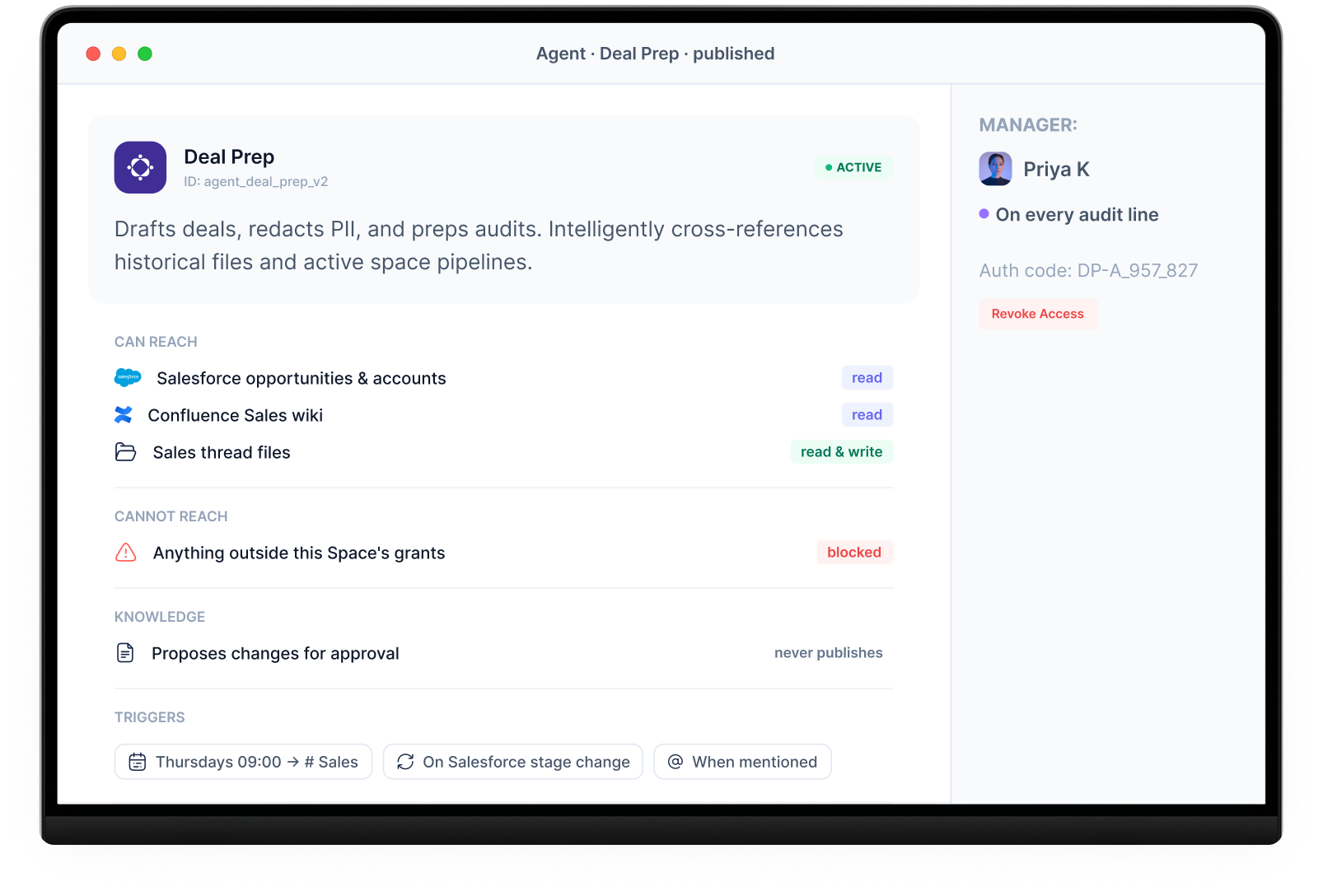
Most AI agents belong to whoever configured them.
Somebody builds something that works. It runs on their account, with their access, answering only when they trigger it. When they change teams it dies with them. When security asks who is accountable for it, there is no answer. When it touches a system it should not have, nobody can prove what it read.
That is why most agent projects stop at a demo. Not capability. Accountability.
An agent a company can actually run in production needs four things: a home, a permission boundary it cannot cross, a person who owns it, and a record of everything it did.
The boundary
An agent acts where two permissions overlap. Never wider.
This is the difference between an agent and a service account. A service account can reach everything its credential allows. An agent can reach only what its Space was granted and what it was separately scoped to, and the smaller of the two always wins.
What # Sales was granted
The Space's knowledge
- Salesforce
- Confluence, Sales wiki
- Drive, Sales collateral
- Sales thread files
- ServiceNow, via IT
Where Deal Prep can act
The overlap, and nothing else
- Salesforce, read
- Confluence, read
- Sales thread files, read and write
Drive and ServiceNow are in the Space, but this agent was never scoped to them. It cannot see them.
What Deal Prep was scoped to
Its own connections
- Salesforce, read
- Confluence, read
- Thread files, read and write
A named manager, accountable
Every agent has a manager who is its only editor and is accountable for re-auth, rejected proposals and spend. Other members request a change rather than making one. That manager's ID is on every audit line the agent produces, and being the manager grants no access to what the agent read.
It proposes, it never publishes
An agent either proposes changes to a knowledge base for approval, or reads it only. Nothing an agent produces enters the company's knowledge without a person saying yes.
Revoke in seconds
Pull a connection, pause the agent in one Space and leave it running in another, or stop it entirely. No ticket, no deploy, no waiting for a quarterly access review.
Building one
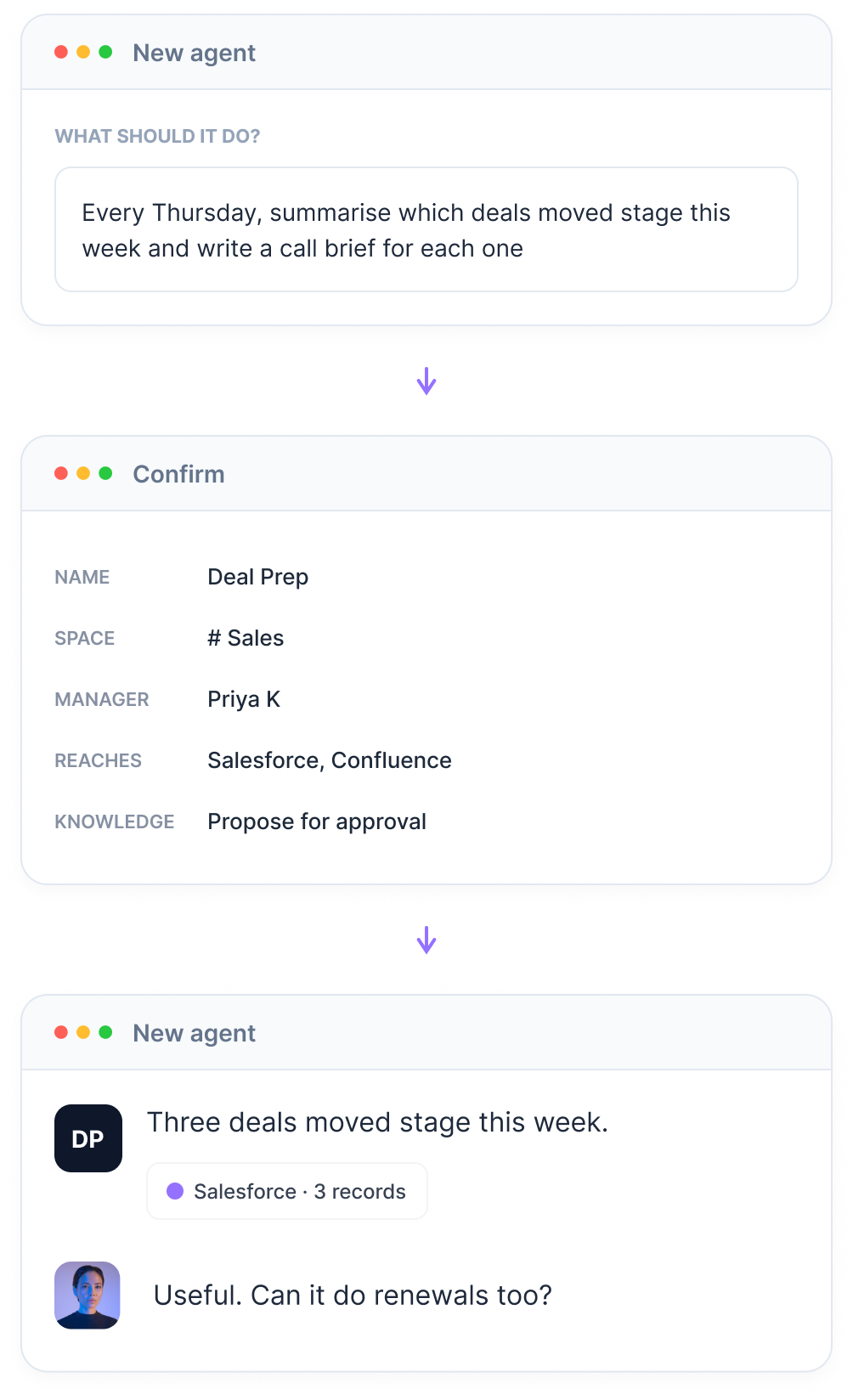
Describe the job. Confirm the agent.
No code, no framework, no repo to maintain. A team lead can build an agent their team uses the same afternoon.
01
Write it in one field
Plain language. No configuration yet.
02
OrgLogic assembles it
You confirm or adjust. The builder is there when you want full control.
03
The team uses it
Publish to the organization and any Space can add it. Governance comes with it.
Skills
Teach an agent how your company does the work.
A Skill is packaged expertise: the reasoning to follow, what to look for, the output format. Written in plain language, not code.
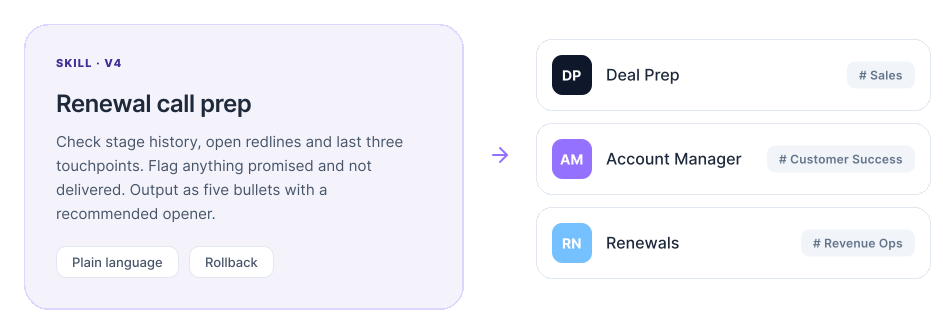
Write it once, use it everywhere
One Skill can be used by many agents. Update it and the change propagates to all of them.
Versioned, with rollback
Full version history. Roll back a Skill that made things worse.
No silent breakage
If a Skill needs a connection the agent does not have, the agent explains what it needs and guides the user to request it, rather than failing quietly or guessing.
Skills are how institutional expertise stops living in one person's head. The way your best account executive prepares for a renewal becomes the way every renewal gets prepared.
Deployment
On demand, on a schedule, or on an event.
When mentioned
Mention the agent in any thread of a Space it belongs to. It answers in the thread with its model and its sources shown, so the whole team sees the same answer.
On a schedule
Cron-based runs that post into a Space thread. The Thursday summary appears where the team is already reading, not in a dashboard nobody opens.
On an external event
A new Jira ticket. A Salesforce stage change. The agent runs and posts into the Space thread.
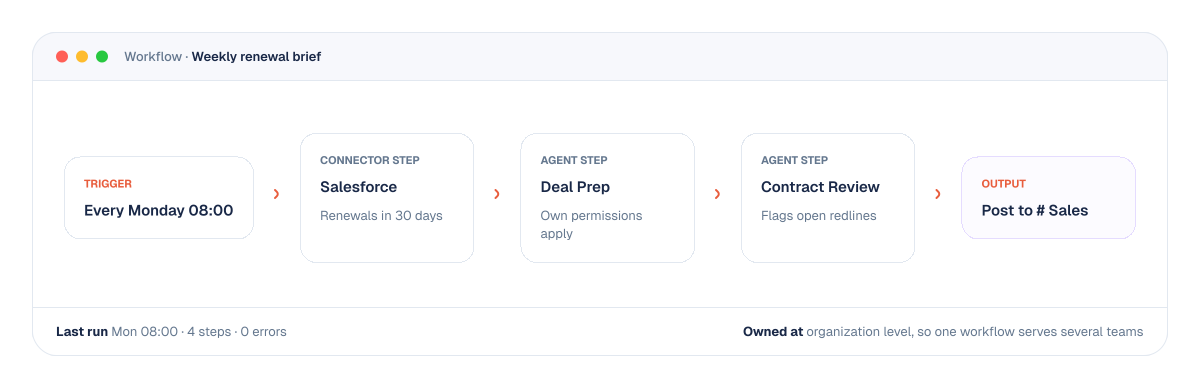
Inside a workflow
A workflow step can run an agent, and that agent's own permissions and manager still apply. Steps, branches and connector reads and writes on a node canvas.
Catalogue
92 agents available to add, across every function.
Start from one that already does the job, rename it, scope it and put it in a Space. Or describe what you need and confirm what gets assembled.
Sales
Deal prep, call briefs, pipeline reports
Marketing
Content in your brand voice, campaigns, translation
Product & Engineering
PR review, debugging, docs from code changes
Support & Success
Ticket triage, drafted responses, escalations
Operations
Process checks, vendor reviews, reporting
HR
Policy lookup, onboarding, JD generation
Finance
Invoice checks, spend summaries, close support
Data & Analytics
Recurring reports, anomaly flags, data questions
IT & Security
Access requests, incident summaries, runbooks
Legal & Compliance
Contract review, risk flagging, compliance documents
Governance
Agents your security team can sign off on.
The reason agent projects stall at review is that nobody can answer what the agent did. Here that is an export.
Per-agent scope, not blanket access
Read or write per agent per connector. The difference between an agent that can read three Salesforce objects and a service account that can read everything.
PII redacted before the model
Every agent call, from every Space, with the rules under your control.
A manager on every line
Accountability is recorded, not assumed. Being the manager grants no access to what the agent read.
Budgets that stop
Per-team limits with hard caps, and cost analytics per agent alongside team, user and model.
Admins decide what is available
Control which agents are available to which teams. Agent approval workflows on every plan.
Agents built elsewhere, governed too
Register an external agent, give it its own gateway credential revocable in one click, and its model traffic inherits your controls and its own audit trail.
In practice
14 agents in production, through a security review first
A pre-opening cognitive city development in Florida, fourteen districts, built by a confidential enterprise, runs 14 agents in production across finance, legal, procurement, investor relations and program management, with CISO sign-off in month one.
Their position going in was that autonomous agents would never clear security review without per-agent permissions and agent-level audit trails. Governance shipped as the first deliverable, before any confidential corpus reached a frontier model. The agents followed.
14
Agents in production
Finance, legal, procurement, investor relations, program management.
Month 1
CISO sign-off
Governance shipped as the first deliverable.
Zero
Confidential leaks
No confidential document has reached an ungoverned model endpoint.
Pricing
Unlimited agents on every plan.
Free
$0
Up to 25 users, no seat minimum, no card.
Unlimited Spaces, threads and agents
Full governance
$500 in pooled model credits
Standard
$8
seat / mo
Up to 25 users, no seat minimum, no card.
Everything in Free
API and SDK
Enterprise
Custom
100 seat minimum.
SSO, SCIM, domain verification
Single-tenant VPC and on-premise
Model usage separately: our keys at cost plus 6%, or your own at zero surcharge.
FAQ
AI agent platform FAQ
What is an AI agent platform?
Somewhere to build, run and govern AI agents that act in real business systems. The parts that matter in production are not the model: a place the agent belongs, a permission boundary it cannot cross, a person accountable for it, and a record of what it did.
Do I need to write code?
No. Describe the job in one field and confirm the agent OrgLogic assembles, or open the builder for full control. Skills are written in plain language too. API and SDK are available on Standard and above.
What can an agent actually do?
Read and write in Salesforce, Jira, Confluence, ServiceNow, GitHub, SharePoint, Notion, Google Workspace, Slack, SAP and any authenticated REST API, within the scope you set per connector.
How do I stop an agent doing something it should not?
Scope it per connector rather than granting blanket access. It acts only where its own permissions and its Space's grants overlap, and the smaller of the two wins. It proposes knowledge changes for approval and never publishes. Revoke a connection in seconds, and admins control which agents are available to which teams.
Who is responsible for an agent?
A named manager, its only editor, accountable for re-auth, rejected proposals and spend. That manager's ID is on every audit line the agent produces. Being the manager does not grant access to what the agent read.
Can agents run on a schedule?
Yes, on cron, on an external event like a new Jira ticket or a Salesforce stage change, or when mentioned in a thread. Scheduled and triggered runs post into a Space thread.
What is the difference between a Skill and an agent?
The agent does the work. The Skill defines how. One Skill can be used by many agents, is versioned with rollback, and updates propagate.
Can we govern agents we built elsewhere?
Register them with a per-agent gateway credential you can revoke in one click, and their model traffic inherits your model controls, budget caps with hard stops, PII redaction before the model and a per-agent audit trail. That scope is model traffic.
What does it cost?
Agents are included on every plan including Free. $0 up to 25 users, $8 per seat per month annually or $10 monthly on Standard, custom on Enterprise. Model usage separately.
Agents that know your business before they act.





An agent is a named AI worker you build for a specific job. You give it a role, attach the Skills that teach it how the work is done, and grant access only to the systems it needs.
Every agent draws on your company brain, so it acts on what your organization actually knows, your accounts, your docs, your decisions, not the public internet.
It runs on demand, on a schedule, or the moment something happens in your systems. Not a chatbot. AI that does the actual work.

Named workers built for specific jobs. Deploy on demand, on a schedule, or trigger from events in your systems. Every agent inherits governance automatically.

Packaged expertise that teaches agents how to work. Authored in plain language. Versioned and reusable: update a Skill once and it propagates to every agent, so your best ways of working compound.

Secure links to the systems where work lives. Each agent gets read or write scope per connection, never blanket access. Revoke any permission
in seconds.

Tell the builder what you need. It drafts the role, instructions, and starting Skills, ready for you to review and adjust.
Pre-built agents for PR review, deal prep, ticket triage, contract review, onboarding Q&A, and more. Live from day one.

Share an agent to the workspace and it inherits governance automatically. Admins control who can use which agent.

Pulls account history, open opportunities, and contacts before every call. No more manual CRM archaeology.

Reviews pull requests against your coding standards, flags issues, and posts feedback directly in GitHub.

Searches the knowledge base and drafts resolutions. Triggered automatically on new ticket creation.
Scans contracts against your approved clause library. Surfaces risk flags with references before review.

Answers employee policy questions, grounded in your actual HR documentation. Cites the source, every time.

Drafts on-brand content using a Brand Voice Skill built on your style guide. Writes in your voice, not a generic one.
Pre-built templates live from day one. Customize with Skills and Connectors to match your systems.

Admins control which agents are available to which teams, and exactly what each agent can read or write.

Usage per agent: who used it, how often, which Skills ran, and what it cost. The numbers you take to budget review.

Skills carry version history. Update once and it propagates to every agent, or roll back if something changes.

Secure links to the systems where work lives. Each agent gets read or write scope per connection, never blanket access. Revoke any permission in seconds.

Who, which agent, what connector, what model, every time. Searchable and exportable, ready for an auditor.

Sensitive data is auto-detected and stripped before any query reaches a model. Configurable at the workspace level.

Bring your own keys and traffic flows directly to model providers; OrgLogic never sees, stores, or trains on it. Zero surcharge, every plan.
600+
Across Troopr Labs
AI products.
91%
Sanctioned tools replaced unmanaged ones.
70%
From roughly $40K a month to $12K.
2 Weeks
Engineers were working in it inside two weeks.
"A publicly traded autonomous vehicle company with around 1,500 employees consolidated 12 AI tools into OrgLogic. Shadow AI dropped 91%, and AI spend fell from $40K a month to $12K, with engineers adopting in two weeks."
- Head of AI Transformation · Publicly traded autonomous vehicle technology company · ~1,500 employees