
Most security programs discovered AI the same way: not as a project, but as a finding. Someone ran a discovery exercise and learned the company was already using fifteen AI tools, three of which had access to the document store, and none of which had been through review.
That is the defining feature of AI security as a discipline. It did not arrive through procurement, so it cannot be managed only through procurement. IBM found 80% of employees use unsanctioned AI tools (IBM, 2025), and puts the additional cost of a breach involving shadow AI at $670K (IBM, 2025).
This guide covers what AI security actually means, where the real vulnerabilities are, which frameworks matter and what they all miss, and how to evaluate and implement controls. It is written for security and technology leaders at companies of 250 to 5,000 employees, where AI adoption has outrun governance.
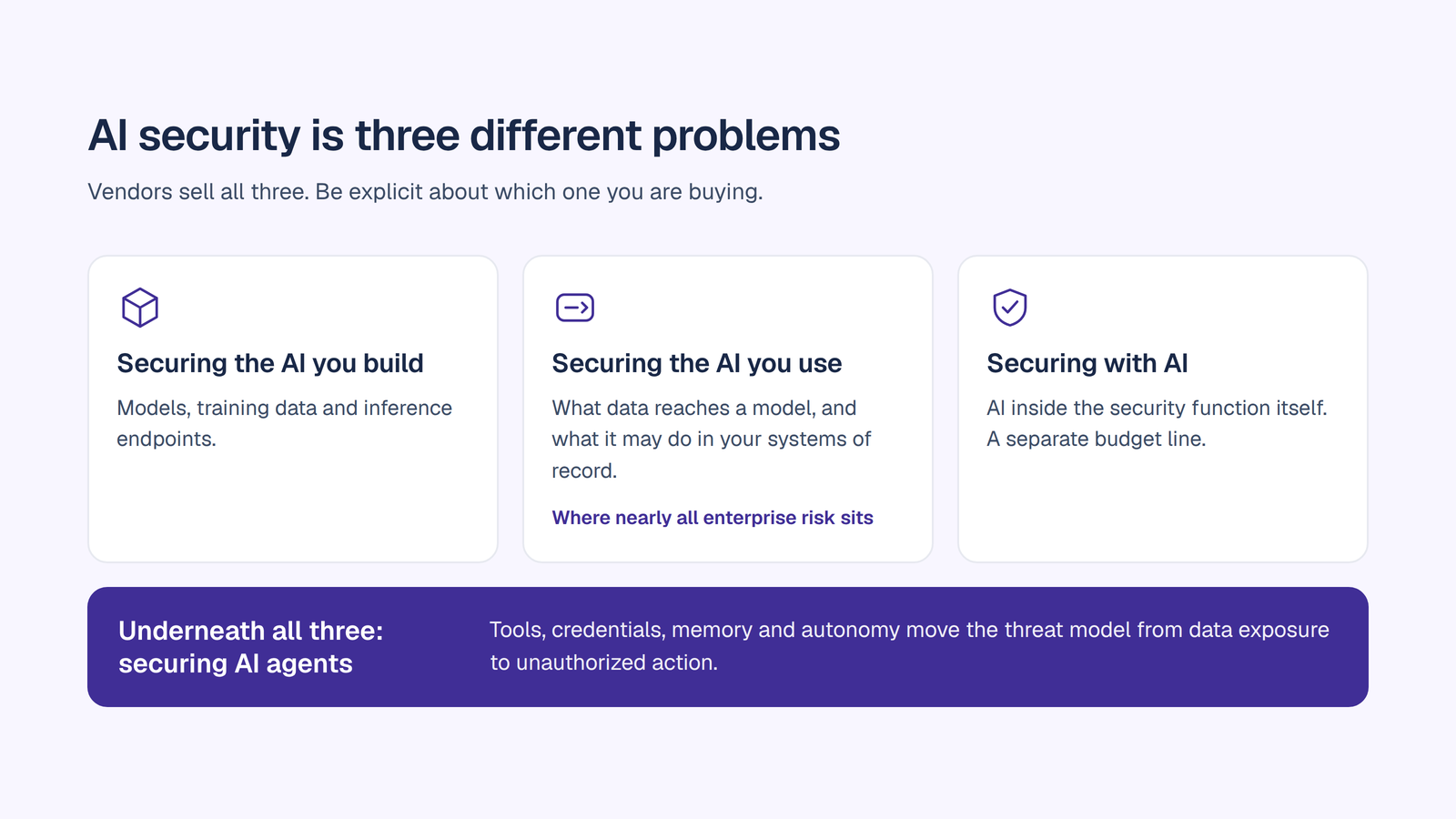
AI security is the practice of protecting artificial intelligence systems, the data flowing through them, and the organization using them, from misuse, compromise and uncontrolled exposure. In practice it splits into three distinct problems that are frequently confused:
Securing the AI you build. Protecting models, training data, inference endpoints and the pipelines around them. This covers adversarial attacks, data poisoning, model theft and extraction, and the integrity of the AI supply chain. If your company ships a product with a model in it, this is your primary exposure.
Securing the AI you use. Controlling how employees and agents interact with third-party AI, what data reaches a model, and what actions an AI system can take in your systems of record. For the large majority of enterprises that consume AI rather than build it, this is where nearly all real risk sits, and it is the least mature area of practice.
Securing with AI. Using AI to improve detection, triage and response in the security function itself. Genuinely useful, and a completely separate budget line. It frequently gets conflated with the first two in vendor conversations, so be explicit about which one you are buying.
A fourth category sits underneath all of them and is worth naming separately: securing AI agents. An agent is not a model answering a question. It is a system with tools, credentials, memory and autonomy, acting in production systems. That changes the threat model from data exposure to unauthorized action, which is a different and larger problem.
The distinction that matters most for budget conversations: AI security is not the same as AI governance, though they overlap heavily. Security asks whether the system can be compromised. Governance asks who is permitted to do what, and what record exists. Most enterprises need both, and in practice the governance layer is where the security outcome gets enforced.
The data exposure is real and it is routine. Employees paste contracts, customer records, source code and financials into AI tools as a normal part of getting work done. Unlike a file transfer or an email attachment, this leaves almost no trace in controls built around those channels. The exposure is not an incident, it is a daily workflow.
AI has moved from answering to acting. Agentic deployments give AI systems credentials and tool access. A compromised or manipulated model that can only produce text is an embarrassment. One that can modify a record, send a message or execute a transaction is a breach, and the controls that distinguish the two are permission scope and audit, not model quality.
The attack surface is genuinely new. Prompt injection has no clean analogue in traditional application security, because the system cannot reliably distinguish instructions from data. Controls designed for SQL injection or cross-site scripting do not transfer directly.
Regulatory expectation is converging on records, not restriction. Regulators are largely not banning AI use. They are requiring that you can show what happened. In the EU, the Digital Omnibus on AI deferred high-risk obligations for standalone Annex III systems from August 2026 to 2 December 2027, and to 2 August 2028 for AI embedded in products already covered by product-safety law. The transparency and AI-content-labeling duties under Article 50, however, took effect on schedule on 2 August 2026, and they apply based on what a system does rather than its risk tier. US companies are in scope when output reaches EU users. The deferral bought time, not exemption.
Procurement now asks. AI security questions are appearing in enterprise security questionnaires and vendor reviews. For any company selling to enterprises, AI security posture has become a revenue question as well as a risk question.
Framed as outcomes rather than controls, because that is how the budget gets approved.
AI adoption actually proceeds. This is the benefit that matters most and it is counterintuitive. Security is usually the reason AI rollouts stall. A program with real controls in place is the reason they ship, because the CISO can sign off on a rollout rather than veto it.
Exposure becomes measurable. Moving from “we think people are using AI” to a per-interaction record changes the conversation with the board, the auditor and the regulator. You cannot defend an exposure you cannot quantify.
Incidents stay small. Scoped credentials and least-privilege agent permissions mean a compromise affects one agent’s access rather than an entire integration. This is the single highest-leverage control in agentic AI.
Audit stops being a project. When every AI interaction is logged with actor, system and data touched, responding to an audit request is an export rather than a reconstruction.
Spend becomes visible. AI security controls that attribute usage per team and per agent also happen to solve the finance problem, which makes the program easier to fund.

1. Inventory before anything else. You cannot secure what you have not found. Pull OAuth grants from your identity provider, thirty days of DNS and proxy logs, expense data for AI vendors, and a source control scan for provider API keys. Then inventory the AI features already enabled inside software you approved. Our shadow AI detection guide covers the method, and shadow AI detection tools compares the products.
2. Enforce policy before the model, not after. Redaction, classification and model permissions applied before a prompt leaves your environment are controls. Applied afterwards they are reporting. This ordering is the single clearest test of whether a platform was architected for security.
3. Give every agent its own identity and the narrowest possible scope. Not a shared API key. A credential per agent, scoped per connected system, with read and write separated, revocable in seconds, and a named human owner recorded on every action. Treat agents like service accounts, because that is what they are. Our guide on how to build an AI agent shows what that scoping looks like in practice, and best AI agent platforms compares how the category handles it.
4. Keep secrets out of model context. Anything in a system prompt should be assumed to be recoverable. Enforce authorization outside the model, never through instructions inside it.
5. Validate outputs before they reach another system. Model output passed unchecked into an API, a database or a browser is an injection vector. Treat it as untrusted input, because it is.
6. Control your own keys. Bring-your-own-key arrangements mean data flows directly to model providers under contracts you hold, rather than through an intermediary’s infrastructure. It also simplifies the data processing conversation in a security review considerably.
7. Log everything, exportably. Actor, agent, accountable owner, system touched, model, input and output. If it cannot be exported to an auditor, it is a dashboard rather than evidence.
8. Cap consumption with hard stops. Unbounded resource consumption is both a denial-of-service vector and a financial one. Alerts do not stop a looping agent. Caps do.
9. Give people a sanctioned option that is genuinely better. Blocking AI tools without providing an alternative moves usage to personal devices, which reduces visibility rather than risk. This is a security control, not a product nicety. An AI workspace carrying every leading model is the usual shape of that alternative, and best enterprise AI workspaces for teams compares the options.
10. Red-team the AI, not just the infrastructure. Test prompt injection, including indirect injection through retrieved documents, before production rather than after.
The reference point here is the OWASP Top 10 for LLM Applications, maintained by the OWASP GenAI Security Project. The 2026 edition was published on 4 August 2026 and is the current list.
Prompt injection holds the top position, as it has in every edition. Anything the model reads, whether a prompt, a web page, a retrieved file, an image or a tool output, can change its behaviour in ways the builder never intended. Indirect injection through retrieved content is the variant that matters most in enterprise deployments, because it does not require the attacker to talk to your system directly.
Sensitive information disclosure sits second: the model surfacing data the requester should not have, whether from training data, retrieved context or another user’s session.
Excessive agency climbed from sixth to third in the 2026 edition, which is the most important movement in the list. It describes an AI system with more permission than its task requires, and it is the risk that turns a model failure into a business incident. This promotion reflects where real incidents now cluster, as agentic deployments moved into production.
Below those three, the list covers supply chain risk in models, datasets and dependencies; data and model poisoning; and unbounded consumption, which rose four places and covers both denial-of-service and runaway cost. The 2026 edition also renamed system prompt leakage to hidden context exposure, and moved improper output handling down to tenth, with eight of the ten entries shifting position overall.
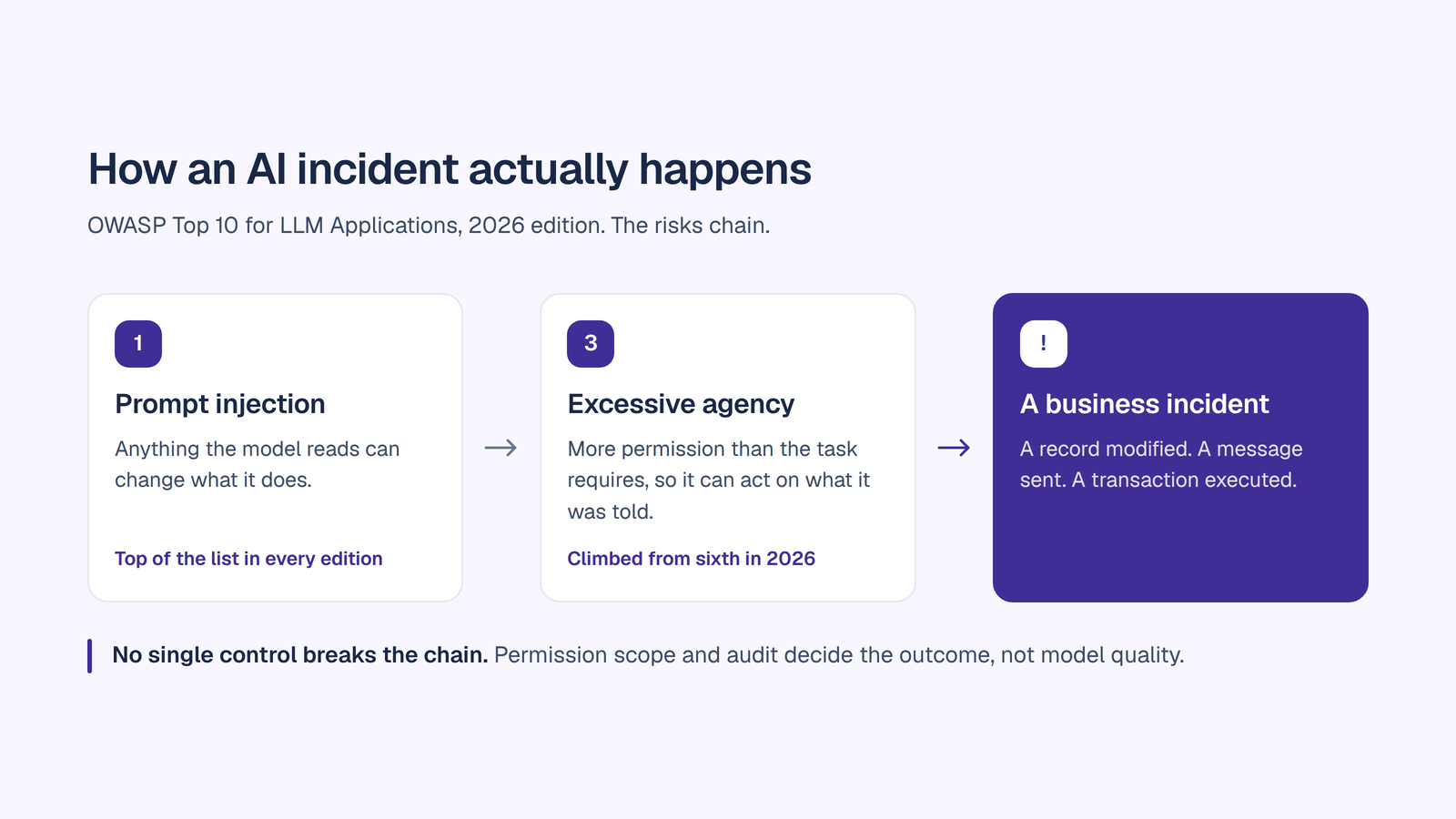
Two things are worth understanding about how these compound. First, they chain: a prompt injection drives a real action through excessive agency using leaked context, and no single control breaks the chain. Second, OWASP now maintains a separate Agentic AI Top 10 extending the list, because tool access, persistent memory, privileged identity and multi-agent communication create risks the LLM list does not fully cover.
Beyond the OWASP lists, the two risks enterprises most often underestimate are ungoverned adoption, which is shadow AI, and third-party model risk, where your exposure depends on a provider’s controls rather than your own.
Start with the frameworks, because they shape what vendors are selling.
NIST AI Risk Management Framework (AI RMF 1.0) is the US reference, organized around four functions: Govern, Map, Measure and Manage. It is voluntary and not certifiable, widely adopted for internal risk programs, and increasingly a de facto expectation in US enterprise and government procurement. As of September 2026 NIST states AI RMF 1.0 is being revised under the White House AI Action Plan, and a preliminary draft Cyber AI Profile, NIST IR 8596, was released in December 2025 mapping AI security to the Cybersecurity Framework.
ISO/IEC 42001:2023 is the certifiable AI management system standard, and the one that functions as a credibility signal in vendor security reviews. It trades ISO 27001’s information security controls for a smaller set of AI-specific ones, and the document discipline from an existing 27001 program largely transfers.
The EU AI Act is the legal layer for anything reaching EU users, with the timing above.
MITRE ATLAS catalogues adversary tactics against AI systems and is the threat-modelling companion to the OWASP lists.
The common 2026 enterprise pattern is to run at least two: NIST as the internal operating model, ISO 42001 as the externally verifiable proof layer, and EU AI Act compliance as the legal requirement where applicable.
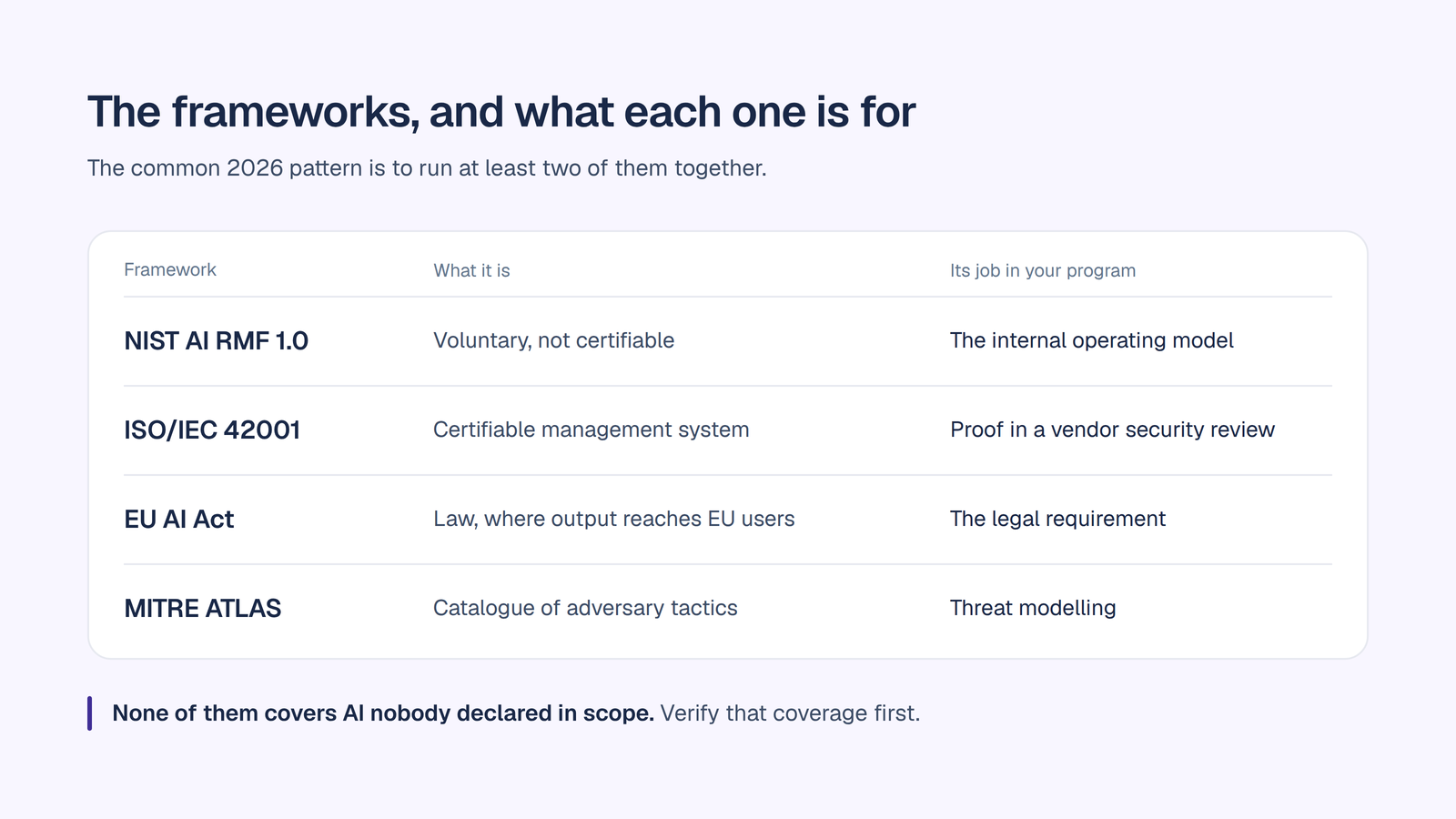
The gap every framework shares, and the one to ask vendors about. Certification confirms that an organization follows a documented process. It does not confirm that the process works, and it does not cover AI the organization never declared in scope. A company can hold a clean ISO/IEC 42001 certificate and a clean SOC 2 Type II report while employees route company data through tools nobody inventoried, because ungoverned adoption is out of scope by definition for most of these frameworks. If you only verify one thing in a vendor evaluation, verify coverage of AI that was never approved.
Questions that separate solutions:
Our enterprise AI workspace checklist turns these into a document you can take into a vendor call. For worked examples against specific platforms, see OrgLogic vs Glean and OrgLogic vs Claude Enterprise.
Phase 1, weeks 1 to 4: baseline. Inventory AI usage from data you already hold. Classify by data sensitivity rather than policy violation, since an approved tool processing regulated data on default settings is a bigger problem than an unapproved tool used for public research. Announce the exercise as discovery, not enforcement, or the data you get back will be worthless.
Phase 2, weeks 2 to 6: pick the framework and write the policy. Choose NIST or ISO 42001 as the spine based on whether you need certification. Write an acceptable-use policy that names permitted tools and prohibited data categories in language a non-technical employee can follow.
Phase 3, weeks 4 to 10: deploy the control plane. Route AI traffic through a point where policy can be enforced pre-model. Turn on redaction, model permissions and consumption caps. Register agents, issue per-agent credentials, and scope connector access. Confirm the audit trail exports in a format your auditor accepts.
Phase 4, weeks 6 to 12: displace, do not just block. Stand up the sanctioned alternative and make it better than what people are using. This is the phase most programs skip and the reason most programs fail: enforcement without a destination relocates the risk. Our AI implementation strategy guide covers sequencing.
Phase 5, ongoing: measure quarterly. Re-run the baseline with the same method so the numbers are comparable, red-team new agents before production, and review agent permissions on the same cadence as any other access review.
Two implementation notes that save real time. Run phases 1 and 2 in parallel rather than in sequence. And bring the people who adopted shadow AI into the design, because the reason they went around IT is the specification for what you need to give them.
Agent identity becomes an access review item. Agents are being treated as principals rather than features: a name, an accountable owner, a scoped credential, a lifecycle. Expect agent inventories in offboarding checklists and quarterly access reviews, not just in AI strategy documents.
Governance consolidates at the gateway. Per-tool admin panels do not compose across ten AI products. The pattern winning out is one routing layer where redaction, model permissions, caps and logging are enforced once and inherited downstream, including by AI nobody centrally procured.
Provenance becomes evidence. Citations and freshness stamps started as user-trust features. With transparency duties now live and record-keeping obligations approaching, they are becoming audit artifacts.
Frameworks converge on agents. NIST’s AI RMF revision, the OWASP Agentic AI Top 10 and the crosswalks between them all point the same way: agent-specific controls are being folded into the existing management-system architecture rather than replaced by something new.
Regulation keeps shifting on timing, not direction. The 2026 deferrals changed deadlines, not expectations. Build for the record-keeping requirement regardless of the date, because the capability takes longer to stand up than any extension lasts.
AI security is three problems wearing one name: securing the AI you build, securing the AI you use, and using AI to secure everything else. For most enterprises of 250 to 5,000 employees, nearly all real exposure sits in the second one, and it is the least covered by both vendors and frameworks.
The practical sequence does not change much by industry. Find what is running. Enforce policy before the model rather than reporting after it. Give every agent its own scoped identity and a named owner. Keep an exportable record. And give people a sanctioned option good enough that they stop going around you, because every control described here only works on traffic that reaches it.
Be precise about scope, because AI security is broader than any one product. OrgLogic is not a model security scanner, a red-teaming service or an AI security posture management tool. It addresses the second problem: securing the AI your organization actually uses, and the agents acting on its behalf. Governance is enforceable on traffic that flows through OrgLogic.
Within that scope it covers the controls this guide identifies as load-bearing:
Enforcement before the model. PII redaction runs pre-model on every call from every Space. Model availability is controlled per organization and per team. Per-team budget caps hard-stop rather than alert, which is the control that answers unbounded consumption.
Per-agent identity and least privilege. Every agent has a named accountable manager who is its only editor, its own connections rather than a shared key, and read or write scope set per agent per connector, revocable in seconds. This is the direct control for excessive agency, now the third-ranked risk in the OWASP 2026 list. The AI agent platform page covers the model.
Your keys, your data path. BYOK on every plan at zero surcharge, with data flowing directly to the model providers and OrgLogic never seeing it. Admin-configured, so end users are never prompted for keys.
An exportable record. Every thread message, agent action and retrieval is logged with the user, the agent, its accountable manager, the connector touched, the model and the cost, searchable and exportable straight to an auditor.
Coverage of AI you did not procure. This is the framework gap named above. External agents and third-party AI clients can be registered in the External Agent Registry and routed through the OrgLogic AI Gateway, where each receives its own credential with one-click revoke and inherits your model rules, caps and redaction, producing a per-agent audit trail. Scope is the model traffic routed through the gateway. Where that AI is a knowledge platform holding the whole document corpus, Glean alternatives covers the trade-offs.
A sanctioned destination people choose. Every leading model in one governed place at $8 a seat with switching mid-conversation and smart routing per task, which is what makes displacement work rather than driving usage onto personal devices.
Governance is on every plan including Free, which matters for evaluation specifically: a security pilot that runs without audit logging is not a pilot. SOC 2 Type II, ISO 27001, HIPAA with a BAA available, GDPR. SSO and SCIM, single-tenant VPC and on-premise on Enterprise.
A pre-opening cognitive city development in Florida put its master plans, designs and investor records in front of frontier models with zero confidential leaks, redacting 1.8M PII items in flight, with CISO sign-off in month one.
What is AI security?
AI security is the practice of protecting AI systems, the data flowing through them, and the organization using them, from misuse, compromise and uncontrolled exposure. It covers three distinct problems: securing AI systems you build, including models, training data and inference endpoints; securing the AI your employees and agents use, including what data reaches third-party models and what actions AI can take in your systems; and using AI to improve security operations. For most enterprises that consume AI rather than build it, the second category holds nearly all the real risk.
Why is AI security critical for enterprises?
Because AI arrived through employees rather than procurement, so it sits outside the controls built for software that was bought. Data reaches models through browser windows that leave little trace, AI systems increasingly hold credentials and act in production systems rather than only producing text, prompt injection has no clean analogue in traditional application security, and regulators are converging on record-keeping requirements that demand you can show what happened.
What are the main AI security risks?
The OWASP Top 10 for LLM Applications, 2026 edition published 4 August 2026, ranks prompt injection first, sensitive information disclosure second, and excessive agency third, having promoted it from sixth. The list also covers supply chain risk, data and model poisoning, unbounded consumption, and hidden context exposure, renamed from system prompt leakage. Beyond that list, the two risks enterprises most often underestimate are ungoverned adoption, meaning shadow AI, and dependence on third-party model providers’ controls.
What are AI security best practices?
Inventory AI usage before buying anything. Enforce policy before the prompt reaches a model rather than reporting after. Give every agent its own credential scoped per connected system with a named accountable owner. Keep secrets out of model context and enforce authorization outside the model. Validate model outputs before passing them to other systems. Hold your own provider keys. Log everything exportably. Cap consumption with hard stops rather than alerts. And provide a sanctioned alternative, because blocking without one moves usage somewhere you cannot see.
Which AI security framework should we use?
Most enterprises in 2026 run at least two. NIST AI RMF 1.0, built on four functions of Govern, Map, Measure and Manage, is voluntary and not certifiable but widely adopted in the US and increasingly expected in procurement. ISO/IEC 42001:2023 is the certifiable management system standard and functions as a credibility signal in vendor security reviews. The EU AI Act is the legal layer for anything reaching EU users. MITRE ATLAS complements them as a threat-modelling catalogue of adversary tactics.
Does ISO 42001 or SOC 2 certification mean our AI is secure?
No. Both confirm that an organization follows a documented process, not that the process is effective, and neither covers AI the organization never declared in scope. An enterprise can hold clean certifications while employees route company data through tools nobody inventoried, because ungoverned adoption is out of scope by definition for most frameworks. Treat certification as a floor for vendor review, not as evidence of coverage.
How is AI security different from AI governance?
Security asks whether a system can be compromised. Governance asks who is permitted to do what and what record exists afterwards. They overlap heavily, and in practice the governance layer is usually where the security outcome is enforced, because permissions, redaction, caps and audit trails are governance mechanisms that produce security results.

Single-model AI tools lock you into one provider at $25-60/seat. OrgLogic is a multi-model AI workspace with named Agents that act in your systems (Salesforce, Jira, Confluence, ServiceNow), packaged Skills for domain expertise, and full governance at $8/seat. You get every model, not just one.

Bring Your Own Key means you connect your own API keys from OpenAI, Anthropic, Google, or any provider. Your data flows directly to the model provider. OrgLogic never sees, stores, or processes your prompts or responses. Zero surcharge on your own keys. This is the #1 requirement for security teams evaluating enterprise AI platforms.
An Agent is a named AI worker with a defined job, connected to your systems via Connectors. A Skill is packaged expertise that teaches an Agent how to do specific work consistently. Unlike a generic chatbot, a Deal Prep Agent with a Salesforce Connector pulls real CRM data and produces structured call briefs. Skills are reusable across Agents, versioned, and authored in plain language.
Every Workspace includes per-Agent Connector permissions (each Agent gets scoped access, not blanket access), Agent-level audit trails, automatic PII redaction, per-team budget controls, model-level access controls, and configurable guardrails. Governance is the default environment on every plan, including Free. SOC 2 Type II, ISO 27001, HIPAA, and GDPR compliant.
The Free plan covers 25 users with $500 in credits ($20 per active user, pooled). The Business plan is $8/seat/month (annual) or $10 monthly. The seat fee covers the full platform: Agents, Skills, Connectors, governance dashboard, 5 surfaces, and all features. Model usage is separate: BYOK at zero surcharge, or OrgLogic-managed models at cost + 6%.
80% of employees already use AI tools without IT approval. OrgLogic replaces fragmented, ungoverned tools with one AI workspace employees actually want to use, available on web, Slack, Teams, Chrome, and API. One customer, a regulated tech company with 1,500 employees, reduced shadow AI by 91% within 6 weeks while cutting AI spend by 70%.
OrgLogic Connectors integrate with Salesforce, Jira, Confluence, ServiceNow, SharePoint, Google Workspace, Slack, SAP, and more via custom APIs. Each Connector has per-Agent permission scopes controlled by IT, so your Deal Prep Agent only accesses the Salesforce objects you approve. The Connector library is growing and new integrations ship regularly.
Self-serve signup takes 30 seconds. Connect your API keys in 2 minutes. Deploy pre-built Agents for sales, support, engineering, HR, and legal on day one. The Free plan (25 users, full governance) lets you pilot without procurement. One customer had engineers adopting within 2 weeks across Slack and Chrome. Enterprise plans add SSO/SCIM, VPC, and on-prem deployment.
