What Is a Company Brain? Definition, How It Works, Uses
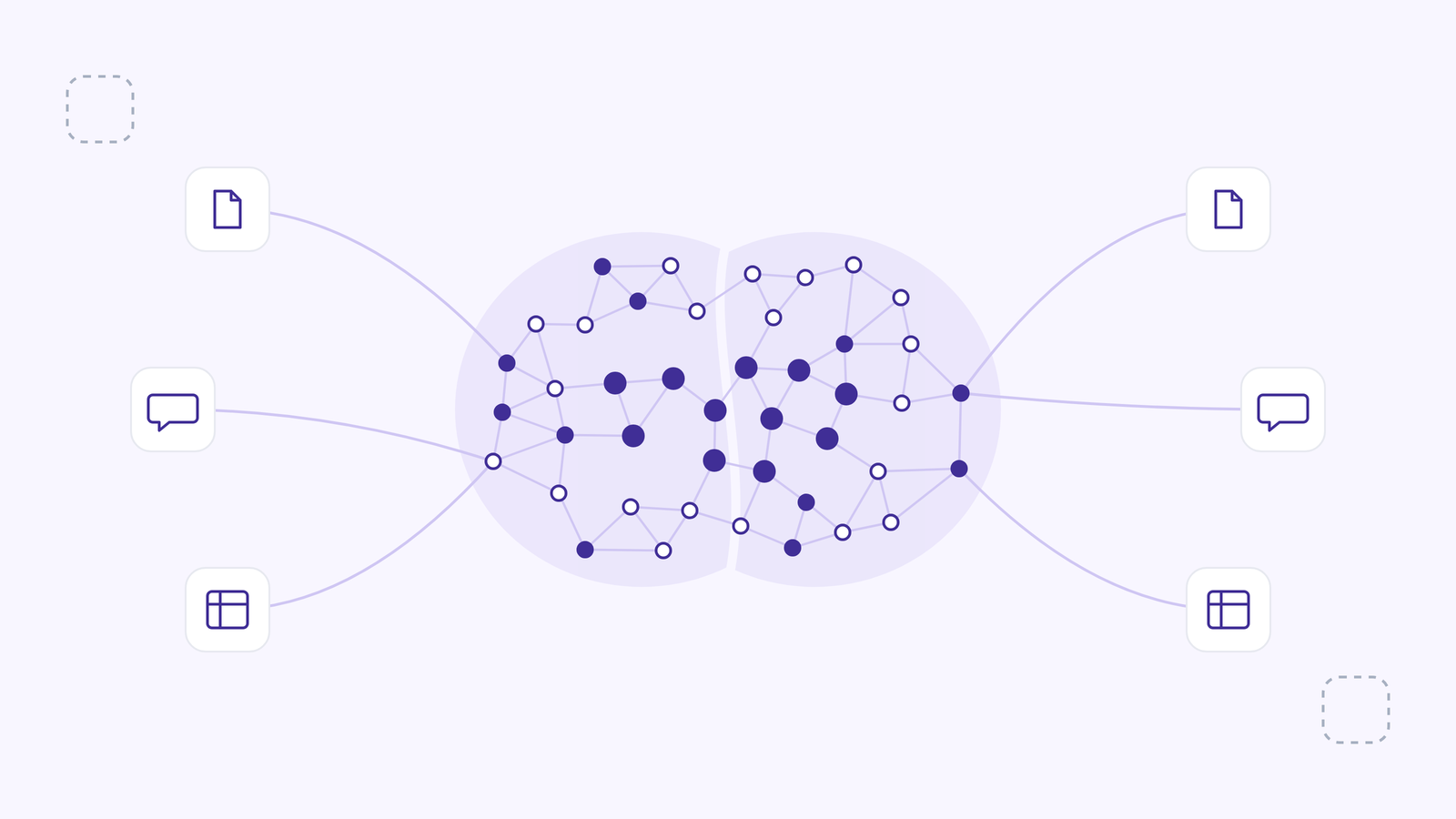
Every company already has a brain. It is just scattered. Decisions live in Slack threads, policies in SharePoint, customer history in Salesforce, project context in Jira and Confluence, and the reasoning behind all of it sits in the heads of a few long-tenured people.
A company brain is the layer that brings that knowledge together so people and AI agents can use it, with answers that cite where they came from and respect who is allowed to know what.
This guide explains what a company brain is, where the idea came from, how company brain software works, what it is used for, how it differs from a data catalog, and what to look for when you choose one. It is written for CTOs, CISOs, IT leaders, AI leaders and department heads who want AI that knows their business without putting that business at risk.
What Is a Company Brain?
A company brain is a grounded, permission-aware knowledge layer that connects an organization’s documents, systems, conversations and decisions. It lets people and AI agents ask questions and get answers that cite the source, show how fresh it is, and stay within what each person is entitled to see.
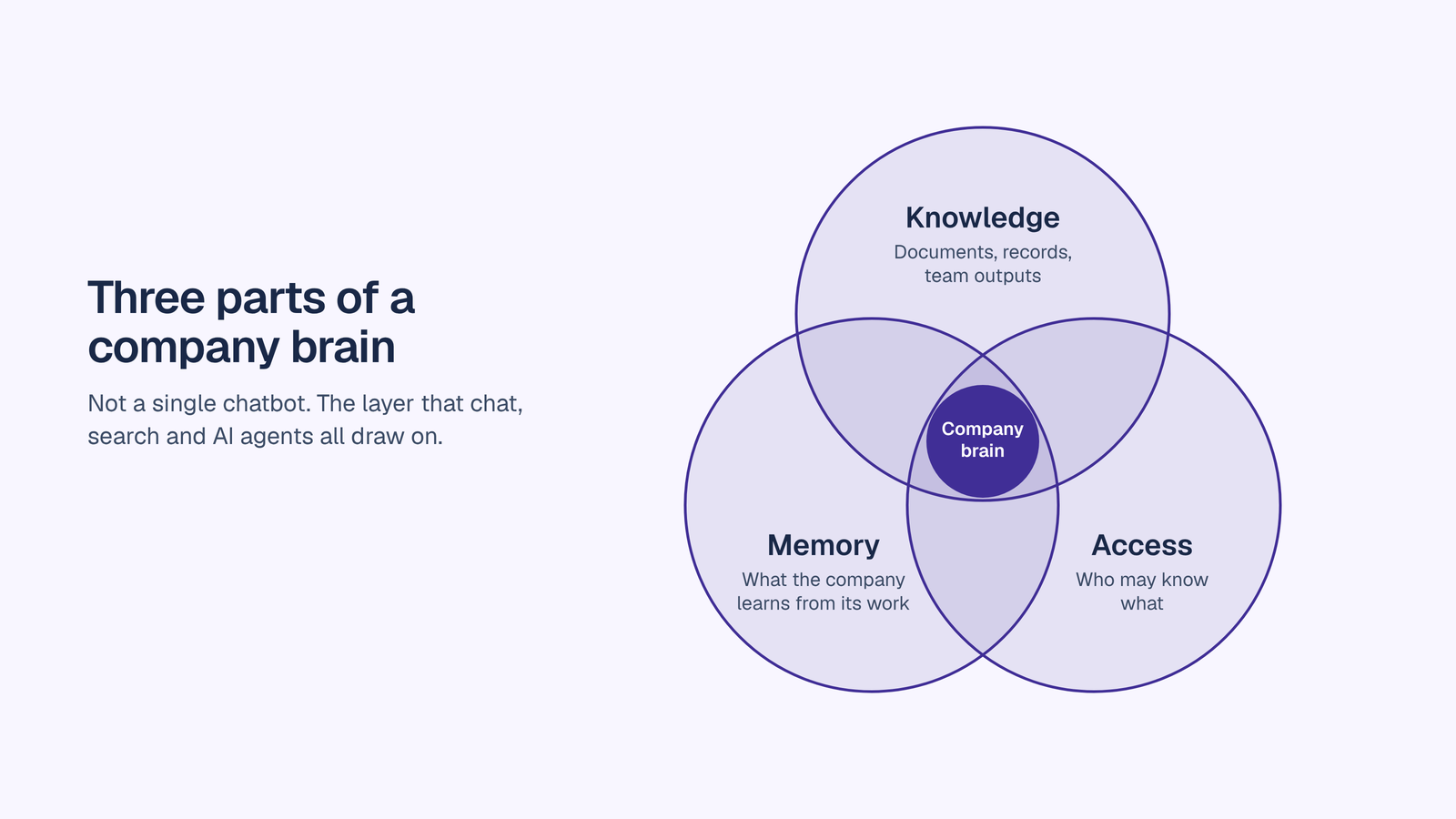
A company brain has three parts:
Knowledge. Documents, pages, records, files and the outputs teams create, drawn from the systems the company already uses.
Memory. What the organization learns from its own work: context from past conversations, decisions and preferences at the level of a person, a team and the whole company.
Access. The rules that decide which person, team or agent may know what.
A company brain AI, sometimes called an AI company brain, is not a single chatbot. It is the layer that chat, search and AI agents all draw on, so every answer and every agent action starts from the same governed source of truth.
Where Did the Company Brain Come From?
The company brain brings together four ideas that developed over three decades.
Organizational memory. In 1991, James Walsh and Gerardo Ungson described organizational memory as the way organizations store and retrieve knowledge from their past. In 1995, Ikujiro Nonaka and Hirotaka Takeuchi’s The Knowledge-Creating Company separated tacit knowledge, held in people’s heads, from explicit knowledge written down.
Knowledge management and enterprise search. Intranets, wikis and document repositories in the 1990s and 2000s tried to capture explicit knowledge. Enterprise search then put one search box across those repositories. Both helped people find documents, but they returned links rather than answers, and content went stale.
The personal second brain. Tiago Forte’s Building a Second Brain popularized personal systems for capturing and reusing what an individual learns. The company brain applies the same idea to a whole organization.
Generative AI, retrieval and open protocols. The 2020 paper that introduced retrieval-augmented generation (RAG) showed that language models could answer from retrieved documents instead of only from training data. In November 2024, Anthropic introduced the Model Context Protocol (MCP), an open standard for connecting AI clients to data sources and tools. Together they made it possible to answer questions from company knowledge, not just find files, and to serve that knowledge to many AI tools at once.
A modern company brain is the combination: organizational memory, made searchable, answered by AI, and governed.
Why Does a Company Brain Matter Now?
AI is only as good as its context. General AI assistants know the public internet. They do not know your pricing, your contracts, your architecture decisions or what your team agreed last quarter.
Employees are already pasting company data into AI. IBM found 80% of employees use unsanctioned AI tools (IBM, 2025). A governed company brain gives them a better source than copy and paste into a personal account.
Search time is a real cost. McKinsey found that workers spend 19% of their time tracking down information (McKinsey, 2012).
AI agents need grounding. An agent that updates Salesforce, triages ServiceNow tickets or reviews GitHub pull requests has to act on current, approved knowledge, not on a guess.
Knowledge walks out the door. When people leave, their context leaves with them unless it lives in shared work.
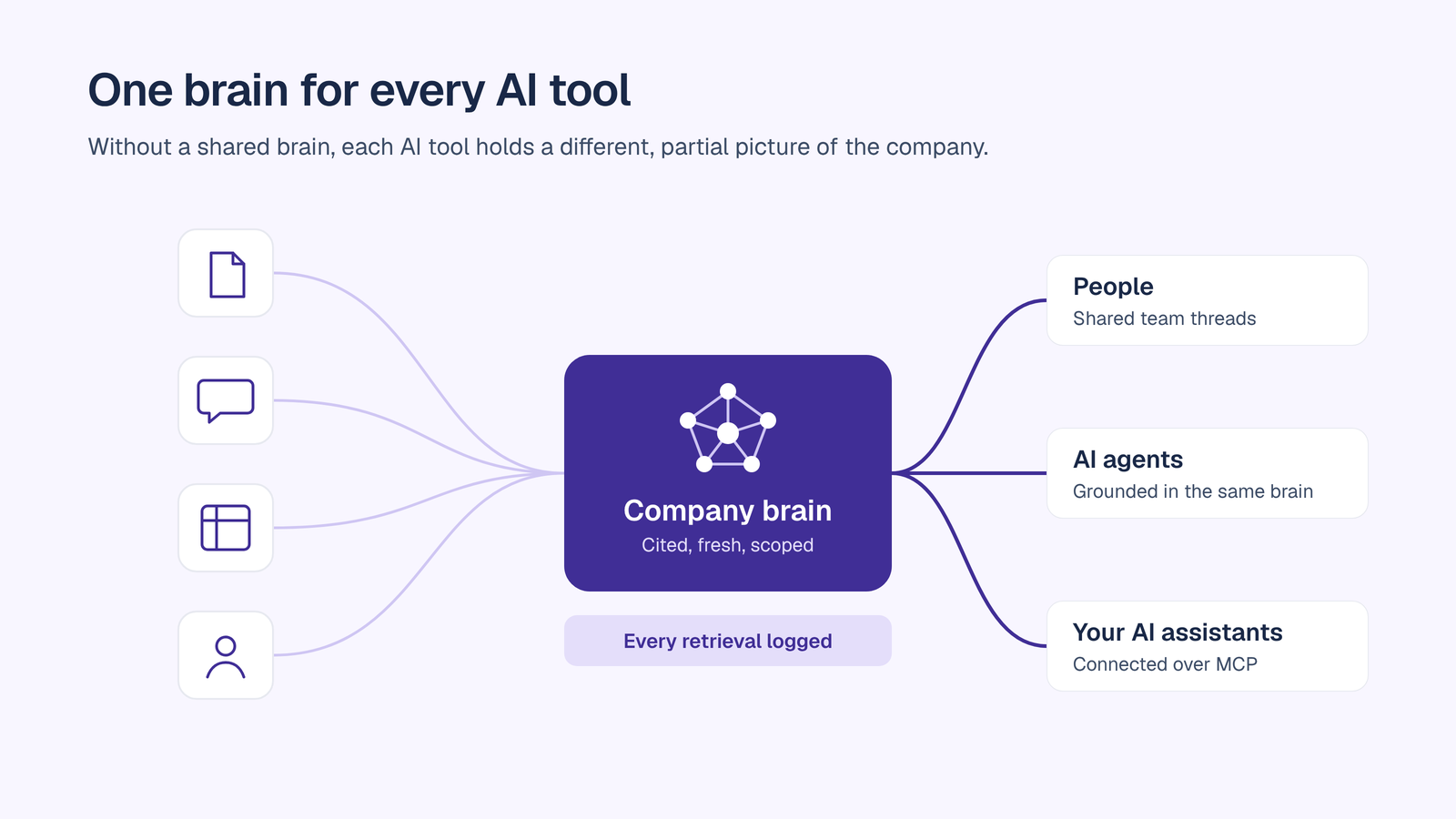
AI tools are multiplying. Teams already use several AI assistants. Without a shared brain, each one holds a different, partial picture of the company.
How Does a Company Brain Work?
Connect sources.Company brain software connects to the systems the company already runs, such as Confluence, Google Drive, SharePoint, Notion, Salesforce, Jira, ServiceNow, GitHub and Slack, and accepts uploaded files, pasted text and websites.
Organize knowledge by owner. Knowledge is grouped into knowledge bases owned by a person, a team or the organization, so each one has a clear scope.
Index and keep it fresh. Content is indexed and re-indexed continuously, so answers reflect the current version of a document rather than last month’s copy.
Retrieve the right passages. When someone asks a question, the brain finds the most relevant passages, typically combining semantic search with keyword search.
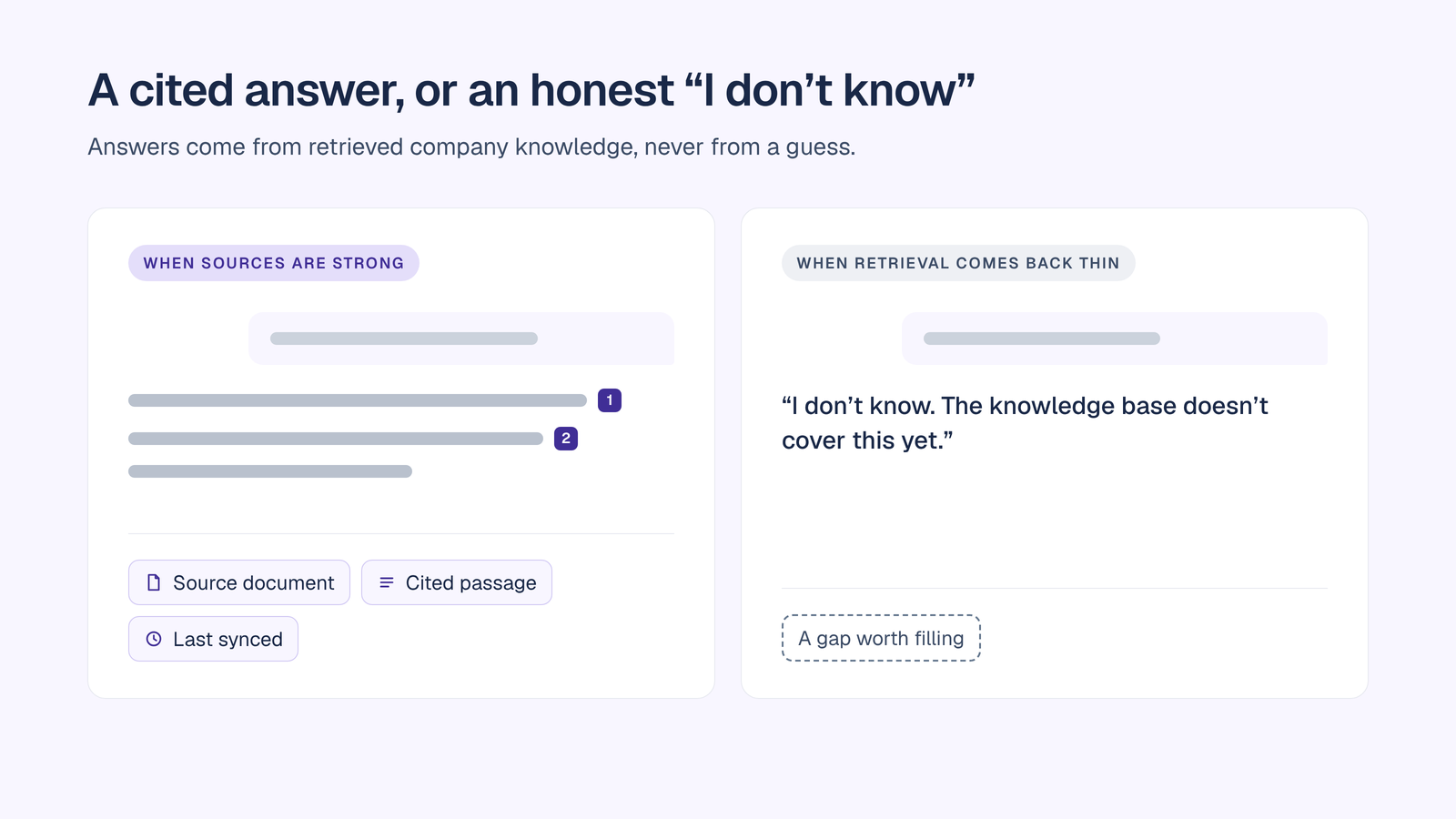
Answer with citations. The model answers from the retrieved passages and cites the documents, the passages and how fresh they are. When retrieval comes back thin, it says it does not know instead of guessing.
Respect access. Each answer contains only what the person or agent asking is entitled to see.
Learn from work. Memory captures context from the team’s conversations, and useful outputs become knowledge the next person can find.
Log every retrieval. Each retrieval is recorded, so security and compliance teams can see who accessed what, from where.
What Challenges Does a Company Brain Address?
Scattered knowledge. The answer exists, but across too many tools for anyone to find quickly.
Repeated questions. Experts answer the same question again and again because the last answer is buried in a private chat.
Slow onboarding. New hires spend weeks learning context that already exists in writing somewhere.
Stale answers. People act on an outdated policy or price list because nothing shows which version is current.
AI that guesses. General assistants produce confident answers with no source and no way to check them.
Across functions, a company brain also grounds AI agents in company knowledge and gives the AI assistants employees already use access to the same source of truth.
What Benefits Have Company-Brain Projects Demonstrated?
Two kinds of evidence show what a company brain changes.
The cost of the status quo. McKinsey found that workers spend 19% of their time tracking down information (McKinsey, 2012). Every question a company brain answers with a cited source is time that does not go to searching, asking around or redoing work.
A governed company brain in production. A pre-opening cognitive city development in Florida put its master plans, designs and investor records in front of frontier models with zero confidential leaks, redacting 1.8M PII items in flight, with CISO sign-off in month one. Its OrgLogic Company Brain connects program management, strategy planning, collaboration platforms and digital-twin metadata, and named AI agents built on top of it are live for enterprise work.
The benefits teams pursue with a company brain follow the challenges above:
Faster answers that cite the source, instead of searching or asking an expert.
Faster onboarding, because a new hire can read the team’s past reasoning on day one.
Safer AI use, because confidential knowledge is used inside governed tools instead of personal accounts.
Grounded agents that act on current, approved knowledge.
One source of truth for every AI tool in the company.
What’s the Difference Between a Company Brain and a Data Catalog?
A data catalog and a company brain both organize what a company knows, but they serve different users and different kinds of knowledge.
A data catalog inventories structured data assets, such as tables, datasets and dashboards, with their metadata, lineage, owners and definitions. Its users are mainly data analysts, data engineers and data governance teams, and its output is a searchable inventory that helps people find and trust data.
A company brain holds knowledge and memory, much of it unstructured: documents, pages, tickets, conversations and decisions. Its users are every employee and every AI agent, and its output is a cited answer or a grounded action.
The two work together. A data catalog’s metric definitions are exactly the kind of knowledge a company brain should be able to cite when someone asks what “net revenue retention” means at your company.
What Should You Look for in a Company-Brain Solution?
Grounded answers with citations. Every answer should cite specific documents and passages, not just name a source.
Freshness on every answer. Users should see how recently a source was synced.
An honest “I don’t know.” The system should decline to guess when retrieval comes back thin.
Permission-aware answers. Each person and agent should get back only what they are entitled to, and personal content should stay personal unless someone deliberately shares it.
Clear scopes. Knowledge and memory should exist at the person, team and organization level.
Memory, not only documents. The brain should learn from the team’s work, not just index files.
Connectors to your systems. Look for the systems your teams use, with read and write access for agents scoped per agent and per connector.
Availability where people work. Web, Slack, Microsoft Teams and the browser, so people do not have to change habits.
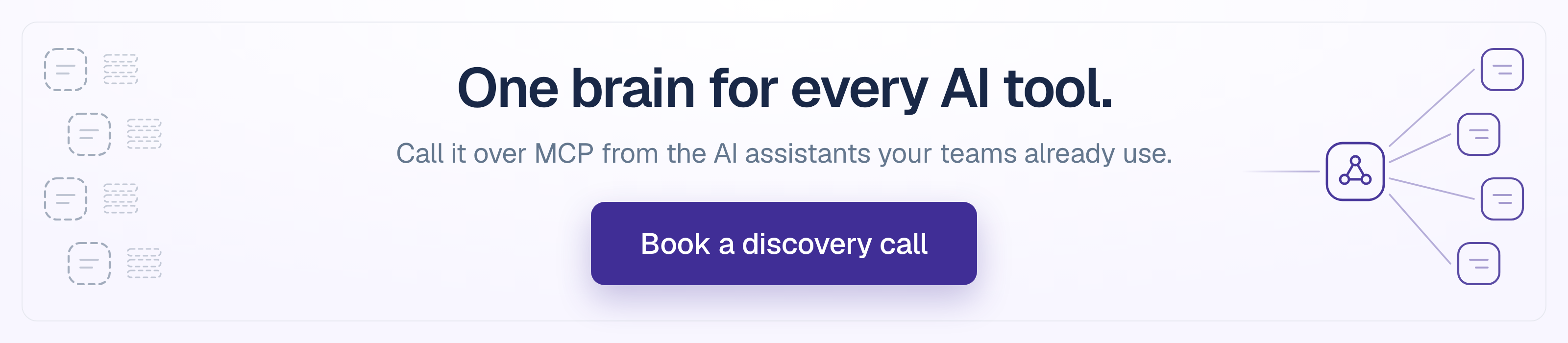
Open access for other AI tools. An MCP endpoint lets the AI assistants your teams already use draw on the same brain.
Governance built in. PII redaction before any model call, bring-your-own-key model access, a contractual commitment not to train on your data, and an audit trail of every retrieval.
Admin control. Admins should see what knowledge each team holds, and be able to restrict or disable external AI access.
Enterprise readiness. SSO, SCIM, VPC or on-prem deployment, and certifications such as SOC 2 Type II and ISO 27001.
Transparent pricing. Seat pricing and model usage should be clear and separate.
Start with one team. Pick a team with a clear knowledge problem and connect its most-used sources first.
Name an owner for every knowledge base. Ownership keeps knowledge current and gives people someone to ask.
Prefer authoritative sources. Connect the system of record, and retire duplicates that cause conflicting answers.
Put knowledge in the right scope. Personal, team and organization knowledge each have a place. Keep sensitive material in the narrowest scope that works.
Make shared work the default. When conversations happen in shared team threads instead of private chats, the brain grows from everyday work.
Treat “I don’t know” as a signal. Each one points to a gap in the knowledge base worth filling.
Ground agents in the same brain. Give each agent only the knowledge and connector access its job needs, with a named owner.
Connect the AI tools people already use. Serve the brain to existing assistants over MCP rather than copying knowledge into each tool.
Review on a schedule. Check usage, gaps and access each quarter, and prune what is stale.
How Does OrgLogic Support a Company-Brain Implementation?
OrgLogic’s Company Brain is the grounded knowledge layer every thread and agent in OrgLogic draws on. OrgLogic is the governed AI workspace where teams and their AI agents work together on shared company knowledge.
Knowledge at the right level
Knowledge exists at user, Space and organization level, and OrgLogic controls access at that level.
Every Space, a team’s shared home, gets its own knowledge base automatically. Thread files, pinned outputs and content agents fetch are indexed into it, so the brain grows from the team’s daily work.
What is in a Space is known by the Space. A person’s own connections, knowledge and memory stay in their Private Space unless they deliberately share them.
Knowledge bases mix uploaded files, pasted text, websites, connected app data and thread content, and can be shared with specific people, a Space or the whole organization.
Connectors include Confluence, Google Workspace, SharePoint, Notion, Salesforce, Jira, ServiceNow, GitHub, Slack, SAP and custom APIs.
Answers you can trust
Answers cite the specific documents and passages they used, and the knowledge base they came from.
The last-synced time appears alongside citations, and indexes refresh continuously.
When retrieval comes back thin, the Company Brain says it does not know instead of guessing.
Interaction memory works at person, Space and organization level.
One brain for every AI tool
The Company Brain is callable over MCP from Claude, ChatGPT and any MCP-capable client, on every plan including Free.
Each request returns only what that user could already retrieve inside OrgLogic, with citations and freshness.
Admins can disable, restrict and monitor MCP connections across the organization.
Agents grounded in the same knowledge
AI agents draw on the same Company Brain, each with a named accountable manager and read or write access per connector.
Each agent’s permission to edit knowledge is set individually: it can propose changes for approval, or read only.
Governance built in
PII is redacted before every model call.
BYOK means data flows directly to model providers and OrgLogic never sees it.
No training on customer data is a contractual guarantee.
Every thread message, agent action and MCP retrieval is logged in an exportable AI audit trail.
SOC 2 Type II and ISO 27001 certified, HIPAA with a BAA, and GDPR compliant. VPC and on-prem deployment are available on Enterprise.
Start free. OrgLogic is free for up to 25 users, and the Company Brain, including access over MCP, is on every plan. Seats are $8 per month on annual billing after that. See pricing.
Create a Space for one team. Connect its two or three most-used sources and upload the documents people ask about most.
Ask real questions. Check that answers cite the right documents and that freshness looks right.
Connect the AI assistant you already use to the Company Brain over MCP.
Add an agent for a repeated task, grounded in the same knowledge.
Scale with a Production Pilot. A Production Pilot is free for 30 days. A Forward Deployed Engineer sets up Spaces, knowledge bases, connectors and agents, and trains your users, and the pilot converts in place.
A company brain is a grounded, permission-aware knowledge layer that connects an organization’s documents, systems, conversations and decisions. People and AI agents ask it questions and get answers that cite the source, show its freshness, and include only what each person is entitled to see.
How is a company brain different from a knowledge base?
A knowledge base is a collection of content. A company brain connects many knowledge bases and live systems, adds memory learned from the team’s work, controls who can know what, and answers questions with citations. A knowledge base is one part of a company brain.
How is a company brain different from enterprise search?
Enterprise search returns a list of links for a person to read. A company brain returns a cited answer, remembers context from past work, and serves the same knowledge to AI agents and AI assistants, not only to people searching.
What is company brain software?
Company brain software connects a company’s systems and documents, keeps them indexed and fresh, controls access, and lets people and AI agents ask questions and get cited answers. It usually includes connectors, knowledge bases, memory, an AI answer layer and governance controls.
Is a company brain secure?
It depends on the software. Look for answers that include only what each person is entitled to see, PII redaction before any model call, bring-your-own-key model access, a contractual commitment not to train on your data, an audit trail of every retrieval, and certifications such as SOC 2 Type II and ISO 27001.
Can I use a company brain with ChatGPT or Claude?
Yes, if the company brain offers an MCP endpoint. OrgLogic’s Company Brain is callable over MCP from Claude, ChatGPT and any MCP-capable client, and returns only what each user is already entitled to retrieve.
How much does company brain software cost?
Pricing varies by vendor. OrgLogic is free for up to 25 users and $8 per seat per month on annual billing ($10 monthly) after that, with the Company Brain included on every plan. Model usage is billed separately, at zero surcharge with your own keys.
How is OrgLogic different from ChatGPT Enterprise or Microsoft Copilot?
Single-model AI tools lock you into one provider at $25-60/seat. OrgLogic is a multi-model AI workspace with named Agents that act in your systems (Salesforce, Jira, Confluence, ServiceNow), packaged Skills for domain expertise, and full governance at $8/seat. You get every model, not just one.
What does BYOK mean and how does it work?
Bring Your Own Key means you connect your own API keys from OpenAI, Anthropic, Google, or any provider. Your data flows directly to the model provider. OrgLogic never sees, stores, or processes your prompts or responses. Zero surcharge on your own keys. This is the #1 requirement for security teams evaluating enterprise AI platforms.
What are Agents and Skills? How are they different from a chatbot?
An Agent is a named AI worker with a defined job, connected to your systems via Connectors. A Skill is packaged expertise that teaches an Agent how to do specific work consistently. Unlike a generic chatbot, a Deal Prep Agent with a Salesforce Connector pulls real CRM data and produces structured call briefs. Skills are reusable across Agents, versioned, and authored in plain language.
What AI governance controls does OrgLogic provide?
Every Workspace includes per-Agent Connector permissions (each Agent gets scoped access, not blanket access), Agent-level audit trails, automatic PII redaction, per-team budget controls, model-level access controls, and configurable guardrails. Governance is the default environment on every plan, including Free. SOC 2 Type II, ISO 27001, HIPAA, and GDPR compliant.
How does pricing work? What does $8/seat cover?
The Free plan covers 25 users with $500 in credits ($20 per active user, pooled). The Business plan is $8/seat/month (annual) or $10 monthly. The seat fee covers the full platform: Agents, Skills, Connectors, governance dashboard, 5 surfaces, and all features. Model usage is separate: BYOK at zero surcharge, or OrgLogic-managed models at cost + 6%.
How do you solve the shadow AI problem?
80% of employees already use AI tools without IT approval. OrgLogic replaces fragmented, ungoverned tools with one AI workspace employees actually want to use, available on web, Slack, Teams, Chrome, and API. One customer, a regulated tech company with 1,500 employees, reduced shadow AI by 91% within 6 weeks while cutting AI spend by 70%.
What systems does OrgLogic connect to?
OrgLogic Connectors integrate with Salesforce, Jira, Confluence, ServiceNow, SharePoint, Google Workspace, Slack, SAP, and more via custom APIs. Each Connector has per-Agent permission scopes controlled by IT, so your Deal Prep Agent only accesses the Salesforce objects you approve. The Connector library is growing and new integrations ship regularly.
How fast can we deploy OrgLogic?
Self-serve signup takes 30 seconds. Connect your API keys in 2 minutes. Deploy pre-built Agents for sales, support, engineering, HR, and legal on day one. The Free plan (25 users, full governance) lets you pilot without procurement. One customer had engineers adopting within 2 weeks across Slack and Chrome. Enterprise plans add SSO/SCIM, VPC, and on-prem deployment.