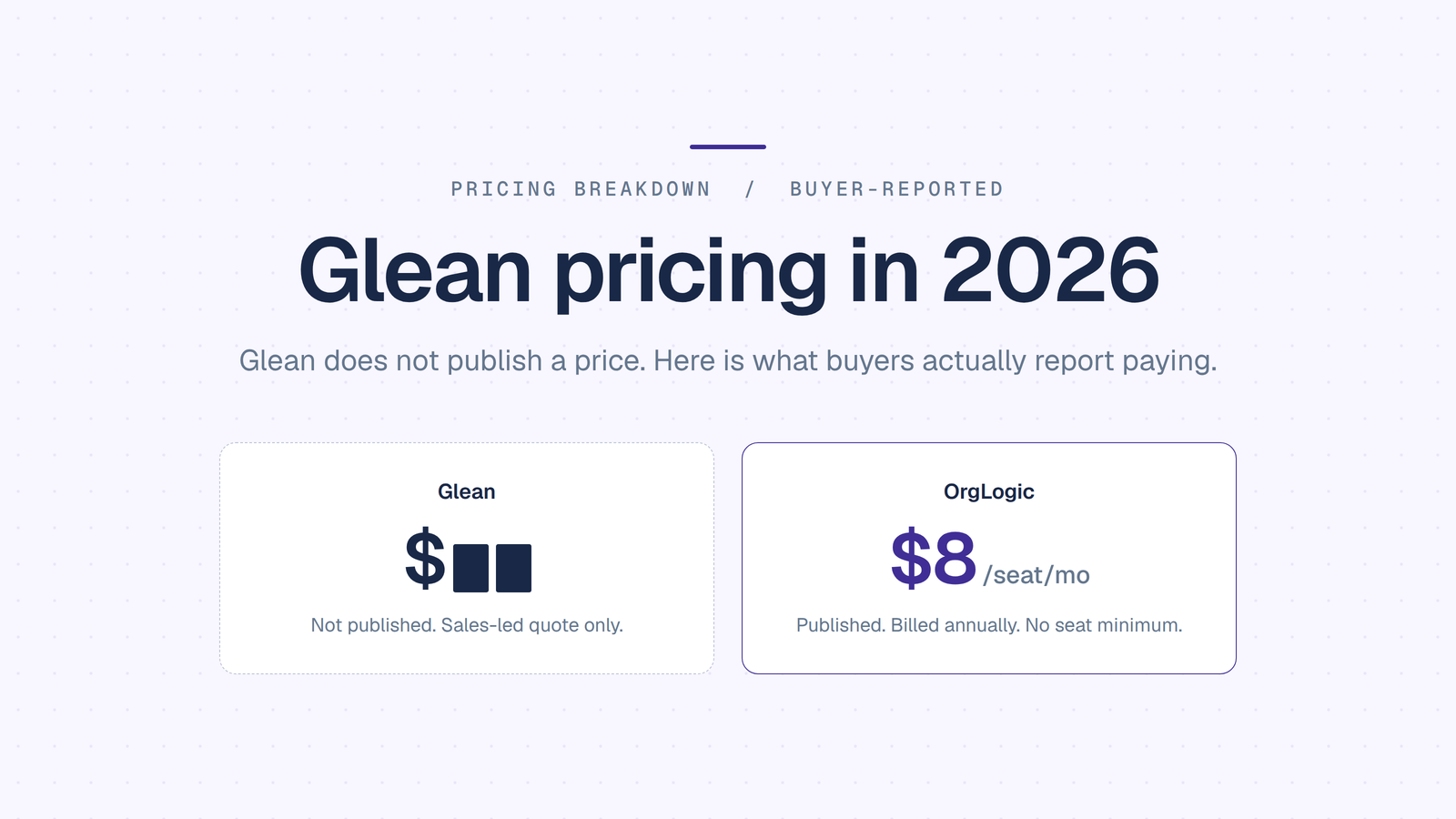
Glean doesn’t put a price on its website. Every deal runs through direct sales, which means the number you get quoted depends on seat count, term length, which surfaces you want, and how well you negotiate.
This guide breaks down what buyers actually report paying in 2026: the base Search license, the Work AI add-on, the seat minimums, the costs that show up after the contract is signed, and what a materially cheaper alternative looks like.
None of these figures come from a published Glean price sheet. They’re drawn from buyer reports, procurement marketplaces (Vendr, TrustRadius, G2), and third-party pricing analyses, which is the only visibility available since Glean sells exclusively through sales-led, negotiated contracts.
Glean’s sales motion is built around a paid proof of concept and a negotiated enterprise contract, not a self-serve checkout. Some buyers report a proof-of-concept fee running as high as $70,000 to test the platform against their own data before a contract is even on the table. That structure makes sense for a platform built around a full-index architecture that continuously crawls and processes every connected system, since standing that up for a trial isn’t free for Glean either. It also means there’s no way to get a real number without a sales conversation, which is the single most common complaint in buyer reviews.
The core product, and the one most directly tied to the “Glean Search” name, is the Enterprise Search License: unified semantic search across every connected app (Slack, Google Workspace, Confluence, Salesforce, Jira, SharePoint, and 100-plus others), returning documents and passages rather than a synthesized answer. Third-party pricing trackers converge on roughly $45 to $50 per user per month for this base license, with some buyers reporting quotes as high as $75.
Glean Assistant, the conversational layer that answers questions in natural language and cites the documents it drew on, has historically been priced as a separate add-on on top of the Search license, reported at roughly $15 per user per month. More recent buyer reports describe Assistant being folded into enterprise plans rather than billed as a line item. Both structures show up in the market right now, which is itself worth knowing: ask explicitly whether a quote includes Assistant or prices it separately, because the answer isn’t consistent deal to deal.
Glean Agents, which execute multi-step workflows rather than just answering questions about them, are generally gated to the Enterprise tier and priced case by case. Beyond the included allowance, premium AI usage meters through a FlexCredits system; one commonly cited allowance is 100 “Thinking Mode” queries per user per week, with overages priced through a sales quote rather than a published rate.
Most enterprise contracts carry a seat minimum around 100 users, which puts a floor on the deal regardless of how many people would actually use it. Combined with the base license rate, that floor commonly lands around $50,000 to $60,000 a year before any usage, add-ons, or implementation costs. Teams below that seat count often can’t get a quote scoped to their actual size at all.
Buyer-reported total cost of ownership routinely runs well above the seat price alone:
Glean’s core job, grounded answers with a source and a citation, isn’t unique to Glean. Company Brain does the same grounding work, citing the source document and its freshness on every answer and saying it doesn’t know rather than guessing when retrieval comes back thin, built into a workspace that also gives you every major model in one place with smart routing and mid-conversation switching, and named Agents that take action in Salesforce, Jira, Confluence, ServiceNow, GitHub and more.
The pricing shape is the clearest difference. OrgLogic starts at $8 a seat a month billed annually ($10 month to month), with a free plan for up to 25 users and no seat minimum on Standard, no proof-of-concept fee, and no sales call required to start. Model usage bills separately either way: OrgLogic’s is zero markup on your own keys (BYOK), or cost plus 6% if OrgLogic provisions the model, with full visibility into spend as it happens rather than a FlexCredits allowance that requires a quote once you exceed it.
Proof, not adjectives. One autonomous-vehicle technology company with about 1,500 employees consolidated 12 AI tools into OrgLogic, cut AI spend 70%, and cut shadow AI usage 91%, with engineers adopting it in two weeks. A publicly traded defense and transportation technology company with 8,000+ employees consolidated 12 AI tools into one governed workspace using BYOK and a dedicated single-tenant VPC. OrgLogic runs 600+ enterprise deployments, including teams at Snowflake, Spotify, Rakuten, Snap, Delivery Hero, Wayfair, Aptean, and Cubic, and is SOC 2 Type II and ISO 27001 certified with a HIPAA BAA available.
If you’re comparing Glean against a wider set of options, not just OrgLogic, the fuller breakdown of six alternatives, including Microsoft 365 Copilot, Google Gemini Enterprise, ChatGPT Enterprise, Claude Enterprise, and Moveworks, is worth reading alongside this one.
See the comparison between Glean vs OrgLogic
Glean doesn’t publish pricing. Third-party reports put the base Enterprise Search License around $45 to $50 a seat a month, with a Work AI/Assistant add-on around $15 a seat on top (though this is sometimes bundled instead), a roughly 100-seat minimum, and a practical floor near $50,000 to $60,000 a year before usage. Large deployments commonly run $200,000 to $480,000 or more a year once infrastructure and onboarding are included.
The base Enterprise Search License, Glean’s original product, is reported at roughly $45 to $50 per user per month, separate from the Assistant add-on (roughly $15 per user per month) and from Agents, which are generally priced case by case on the Enterprise tier.
No. Glean has no published free tier and no standard free trial. Some buyers report a paid proof of concept, reported as high as $70,000, to evaluate the platform against their own data before a contract is signed.
Most enterprise contracts carry a seat minimum around 100 users, putting a practical floor near $50,000 to $60,000 a year even before usage, add-ons, or implementation costs. Teams below that size often can’t get a quote scoped to their actual headcount.
Commonly reported additions include FlexCredits usage beyond the included allowance, premium support at around 12% of license fees, implementation and professional services, infrastructure costs in bring-your-own-cloud deployments, and renewal increases of 7% to 12% a year if not capped in the contract.
Yes. OrgLogic offers the same grounded-search job plus multi-model chat and Agents that take action, starting at $8 a seat a month with no seat minimum and a free plan for up to 25 users, against Glean’s roughly $45-to-$50-plus seat and 100-seat floor.
At 300 seats, OrgLogic Standard runs about $2,400 a month, or $28,800 a year, billed annually. The same 300 seats on Glean, combining the reported Search and Assistant pricing, run roughly $18,000 to $19,500 a month, or $216,000 to $234,000 a year, before FlexCredits usage, implementation, or support fees. Both platforms bill model usage separately from the seat fee.
Glean’s real cost isn’t the number on the first sales call. It’s the base license plus the Assistant add-on plus the seat minimum plus the FlexCredits overage plus the renewal increase, and most of that only becomes visible once you’re already in a negotiation.
OrgLogic does the same grounded-search job, adds every major model and Agents that act, and prices it at $8 a seat with no minimum, so the number you see is the number you pay.Start free for up to 25 users, or book a demo if you’re planning a company-wide rollout.

Single-model AI tools lock you into one provider at $25-60/seat. OrgLogic is a multi-model AI workspace with named Agents that act in your systems (Salesforce, Jira, Confluence, ServiceNow), packaged Skills for domain expertise, and full governance at $8/seat. You get every model, not just one.

Bring Your Own Key means you connect your own API keys from OpenAI, Anthropic, Google, or any provider. Your data flows directly to the model provider. OrgLogic never sees, stores, or processes your prompts or responses. Zero surcharge on your own keys. This is the #1 requirement for security teams evaluating enterprise AI platforms.
An Agent is a named AI worker with a defined job, connected to your systems via Connectors. A Skill is packaged expertise that teaches an Agent how to do specific work consistently. Unlike a generic chatbot, a Deal Prep Agent with a Salesforce Connector pulls real CRM data and produces structured call briefs. Skills are reusable across Agents, versioned, and authored in plain language.
Every Workspace includes per-Agent Connector permissions (each Agent gets scoped access, not blanket access), Agent-level audit trails, automatic PII redaction, per-team budget controls, model-level access controls, and configurable guardrails. Governance is the default environment on every plan, including Free. SOC 2 Type II, ISO 27001, HIPAA, and GDPR compliant.
The Free plan covers 25 users with $500 in credits ($20 per active user, pooled). The Business plan is $8/seat/month (annual) or $10 monthly. The seat fee covers the full platform: Agents, Skills, Connectors, governance dashboard, 5 surfaces, and all features. Model usage is separate: BYOK at zero surcharge, or OrgLogic-managed models at cost + 6%.
80% of employees already use AI tools without IT approval. OrgLogic replaces fragmented, ungoverned tools with one AI workspace employees actually want to use, available on web, Slack, Teams, Chrome, and API. One customer, a regulated tech company with 1,500 employees, reduced shadow AI by 91% within 6 weeks while cutting AI spend by 70%.
OrgLogic Connectors integrate with Salesforce, Jira, Confluence, ServiceNow, SharePoint, Google Workspace, Slack, SAP, and more via custom APIs. Each Connector has per-Agent permission scopes controlled by IT, so your Deal Prep Agent only accesses the Salesforce objects you approve. The Connector library is growing and new integrations ship regularly.
Self-serve signup takes 30 seconds. Connect your API keys in 2 minutes. Deploy pre-built Agents for sales, support, engineering, HR, and legal on day one. The Free plan (25 users, full governance) lets you pilot without procurement. One customer had engineers adopting within 2 weeks across Slack and Chrome. Enterprise plans add SSO/SCIM, VPC, and on-prem deployment.